I hope everyone had a great 4th of July. The wife-formerly-known-as-sweetie and I went to visit the now-for-reals-stepdaughter. We had a good meal and then ice cream at Braums.
And then, on the drive back, we got to see lots of fireworks. It’s happened of late that I’m driving on the 4th of July evening, and it’s quite enjoyable to see fireworks lining the hills off in the distance. It’s a movable feast of “oooh” and “aaah.”
The Forgotten King
The big news this week is the cover reveal for The Forgotten King by Mark Stallings. This is another great cover from Jake Caleb, who is an absolute rock star.
With all that’s happened of late, between wedding, Lilies, and holiday, I’m a little behind revealing the cover as The Forgotten King comes out next Tuesday. Where did all the time go?
Anyway, this is a fast-paced swords and sorcery tale that has LitRPG influences along with epic fantasy. It’s really fun.
This past week was a good one working on Embers & Ash. This is by Marie Whittaker and introduces us to Pyranon, the last of the five continents in the Eldros Legacy. This is a coming of age princess epic fantasy merged with some gothic influences and you’re going to love it.
You’re also going to love some of the things coming down the road. Full release schedule is below, but we’re starting to get to the point where New Mythology is getting to two books a month.
There’s stuff coming from Chris Nuttall, Trisha Wooldridge, G. Scott Huggins, Courtney Farrell, Kendra Merritt, and Jamie Ibson. It’s a great list of authors I’m proud to work with and these are great stories.
With that, it’s time for me to go record the next Dudes in Hyperspace podcast.
What I’m Listening To
Gordon Lightfoot’s Canadian Railroad Trilogy. This might surprise those of you who think I only listen to Rush and metal, but this is one of those I have hear a couple times every time it pops up in the rotation.
Quote of the Week
Today is a bit of a holiday in my mind, at least it should be. It’s Robert Heinlein’s birthday and I owe so much to him. First, the stories. Second, his books were one of my favorite memories of my father and how we connected.
There are so many quotes from Heinlein to choose from. I’ll take the one that really encapsulates my vision of work.
“Progress isn’t made by early risers. It’s made by lazy men trying to find easier ways to do something.”
The latest show includes an interview with the mighty Chris Kennedy himself. We just recorded a show entitled Crafting Short Stories v. Series which will be out in the next day or two.
And this time, it’s a video! You get to see our smiling faces.
The theme is Bonds of Valor, and you story must include deeds of valor centered around bonds between characters. This could be a romantic relationship, a buddy adventure, oaths to kings, or whatever you can come up with.
Deadline: November 30th, 2022
Word Count: 7-10,000 words
Specifics: Times New Roman, 12 point font, 1.5 line spaced.
It must also be a fantasy story. Any type is welcome, urban, epic, high, western, gothic, whatever, it just have to have magic. Finally, it cannot have been published anywhere else before.
I’m currently working on Embers & Ash, the next Eldros Legacy novel.
New Mythology Schedule
July 12th: The Forgotten King (Eldros Legacy 6), by Mark Stallings
August 16th: Embers & Ash (Eldros Legacy 7), by Marie Whittaker
September 13th: Dark and Secret Paths (Eldros Legacy 8), by Courtney Farrell
September 20th: Chimera Coup ( Chimera 1), by Chris Nuttall)
October 4th: Heart, Wings Fire (27 Kingdoms 1), by Trisha Wooldridge
October 11th: The Pain Bearer (Eldros Legacy 9) by Kendra Merritt
November 8th: A Murder of Wolves (Eldros Legacy 10) by Jamie Ibson
November 22nd: Responsibility of the Throne (Endless Ocean 2), by G. Scott Huggins
This isn’t a giveaway, it’s a collection of books and authors that Kacey Ezell thinks rocks. I’m honored to be listed here, and take a look and see what else is there.
This week’s new release is Fallen Hunter, Book 2 of Mike Wyant’s Anisian Convergence. Get it here: amazon.com/dp/B0B5D91VTM. More space opera from CKP!
And don’t forget, The Forgotten King by Mark Stallings, sixth book in the Eldros Legacy, comes out on Tuesday the 12th.
Tracked Items
Today’s Weight: 323.0
Updated Word Count: 145,521
Eldros Legacy Archives: 813 entries
Let me know if you have any suggestions on the website, this email, or cool story ideas at rob@robhowell.org. Especially let me know of suggestions you have for the Spotlight section.
In honor of the upcoming release of Keen Edge of Valor, I thought I’d provide some interviews of the authors in the anthology throughout March. Today, we start with Jamie Ibson, who actually is one of the reasons I got started with New Mythology Press.
Jamie asked Chris to do an anthology involving altered humanity. That was We Dare, and I have a fun story in there (And a fun story about that fun story). Anyway, others had asked as well, including James Young and his magnificent Phases of Mars series of alternate military history, of which I have the honor to be in all three.
But these other anthologies prompted me to ask Chris, may I do an anthology of fantasy stories? That became When Valor Must Hold, and from that I have ended up here with New Mythology.
OK, enough about that, on to the interview.
Jamie Ibson
Why are you here? This includes influences, favorite creators, steps along the way, and dreams down the road.
Jamie ibson
Kevin Ikenberry and Michael Z Williamson have taught me more, directly, about the craft of storytelling than anyone I can think of.
More generally I grew up reading D&D fantasy like the Forgotten Realms books, SF off my Dad’s bookshelf like Robert Heinlein, Gordon R Dickson, Spider Robinson, and Joe Haldeman.
These days I often find little aspects of gaming I find intriguing – for example, using crystals to power magical effects in the Westlocke stories (ed. note: You can find the first two in Songs of Valor and Keen Edge of Valor) comes directly from a Fridge Horror moment playing Skyrim where I was slaying wolves left and right, charging up my soul gems, and went “wait… doesn’t this make me the Fantasy equivalent of the machines from the Matrix?”
“Creators” is a great non-specific term and some of my favorite YouTube videos are of self-made musicians like Leo Moracchioli, who is an absolute maniac in Norway pumping out a new heavy metal cover song, with video, every Friday. His music often accompanies me as I write. He plays a bajillion instruments, sings, growls, records, produces, edits video, and generally is only not a one-man show when it comes to bringing in guests or going on tour.
I’m also heavily into mashup songs, where an artist will take, say, the Ghostbusters theme song and overlay the Gangnam Style lyrics to it and it’s genius.
Book-wise, falling in with the CKP crowd has been tremendous. With all the foolishness going on in the world, having a regular Saturday night video call with friends literally all over the globe, with conversations that sometimes last 6, 7, 8 hours has been a boon to my mental health.
I became a creator in the first place at LibertyCon 30, when I learned it wasn’t nearly as impossible as I believed it to be. I chose to create because I found my people. Science fiction and fantasy nerds are best nerds.
Fingers crossed, I would like someday, perhaps someday soon, to narrate one of my own works.
Describe your great Lab of Creation? This includes where you work, what do you listen to (if anything), things you have to have in your work environment, and stuff you’ve tried that haven’t worked.
I work at home. Used to be in the attic, now it’s in a room on the 2nd floor of the house. I’ve got two scratching posts to my right, my bar fridge to my left, my RPG gamebooks over my left shoulder and my RPG figures/miniatures in a cabinet over my right shoulder.
I was originally in the attic, but the floor up there is uneven and I found the ergonomics was putting me in for massage and chiropractic more often than I’d like. The floor literally dropped 4” over 15’. (That’s bad.) The floor in here is much more even.
Gizmo Helping (Jamie needs all the help he can get)
As I mentioned above… Leo Moracchioli, Holocene, and First to Eleven for covers. DJ Schmolli, DJ Cummerbund, William Maranci, Bill McClintock all do mashups. When I’m feeling nostalgic I might listen to Soundgarden, Perturbator, Foo Fighters (especially their live stuff, especially Monkey Wrench featuring Kiss Guy), or electroswing like Caravan Palace.
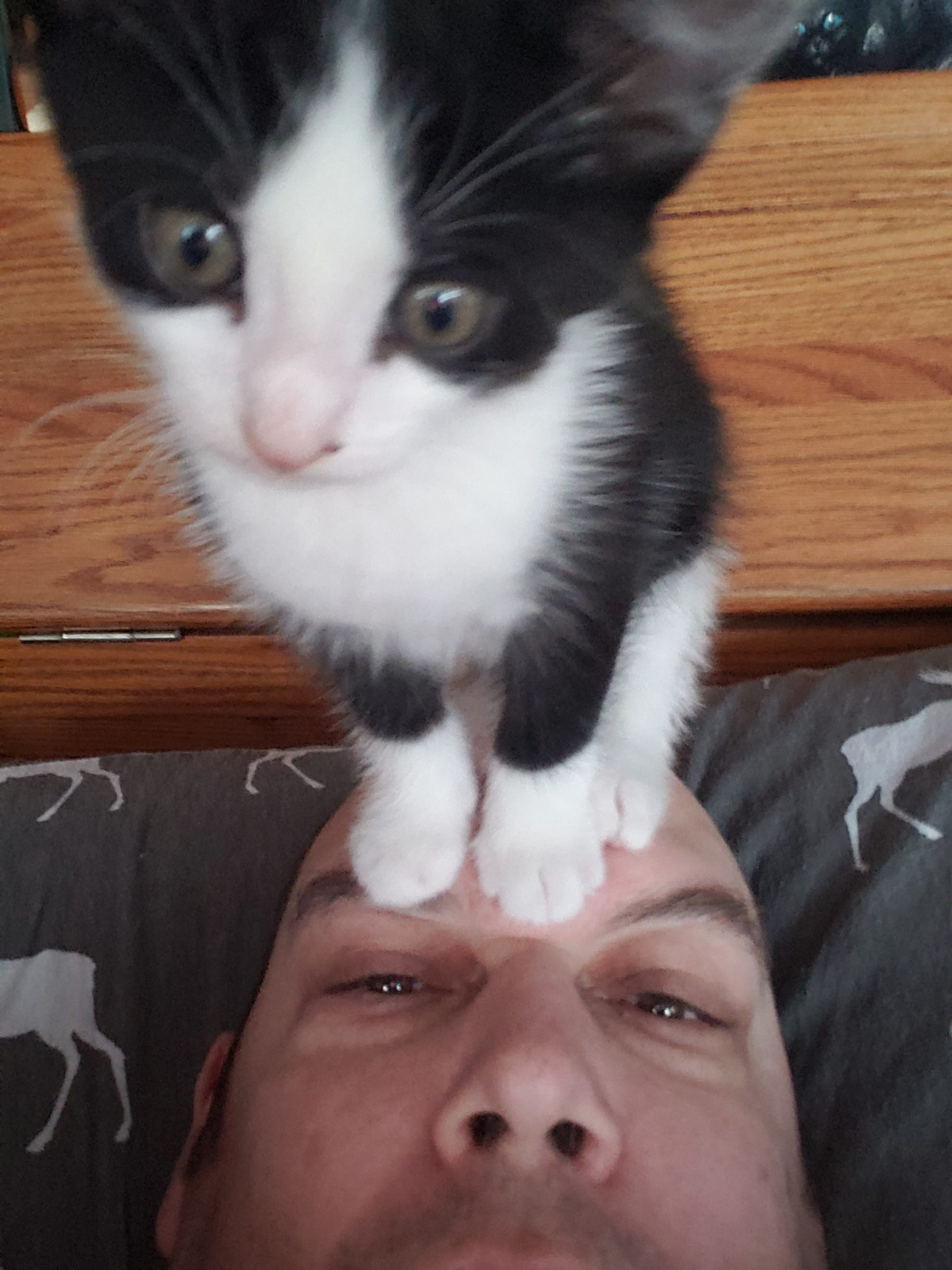
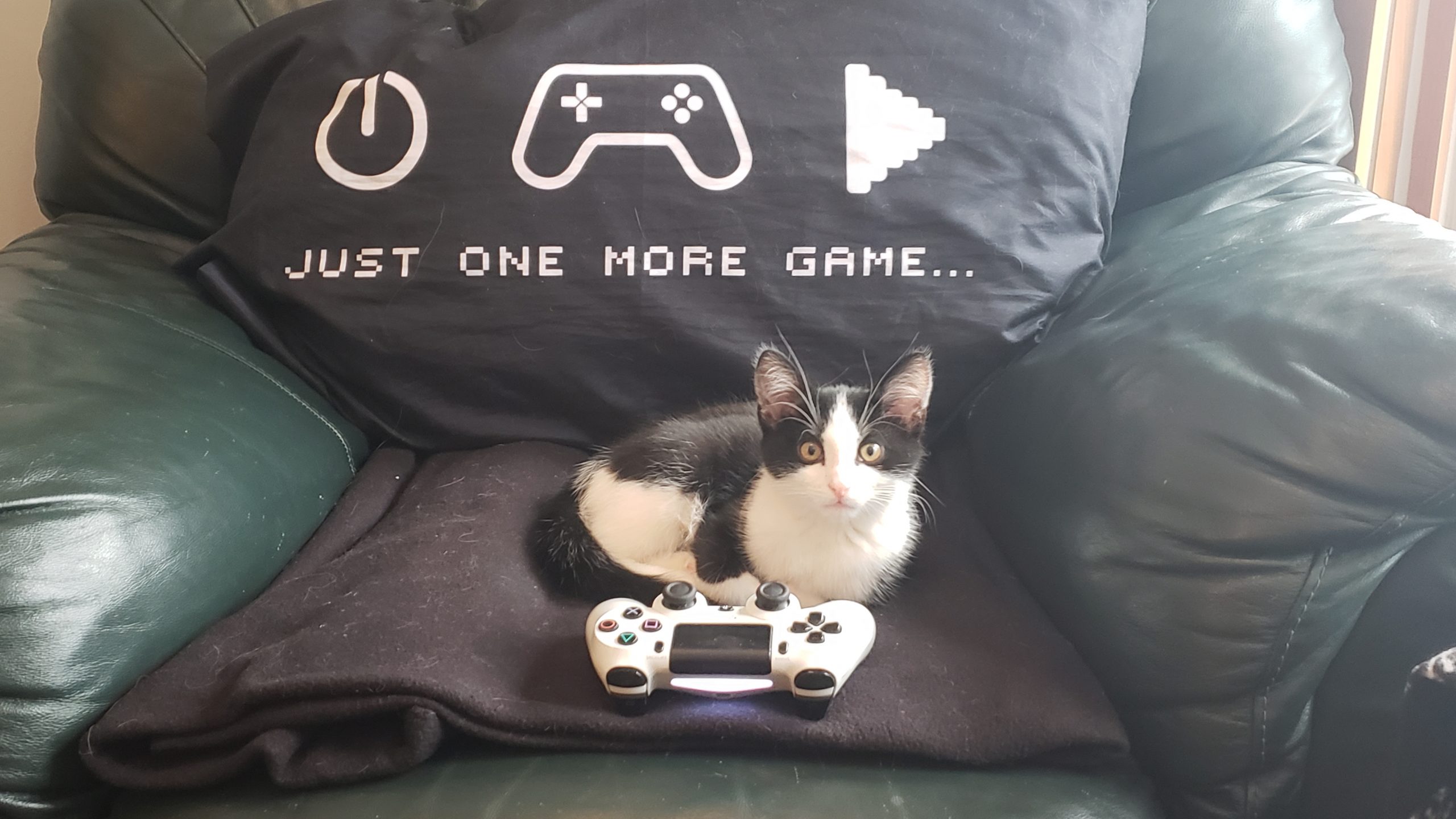
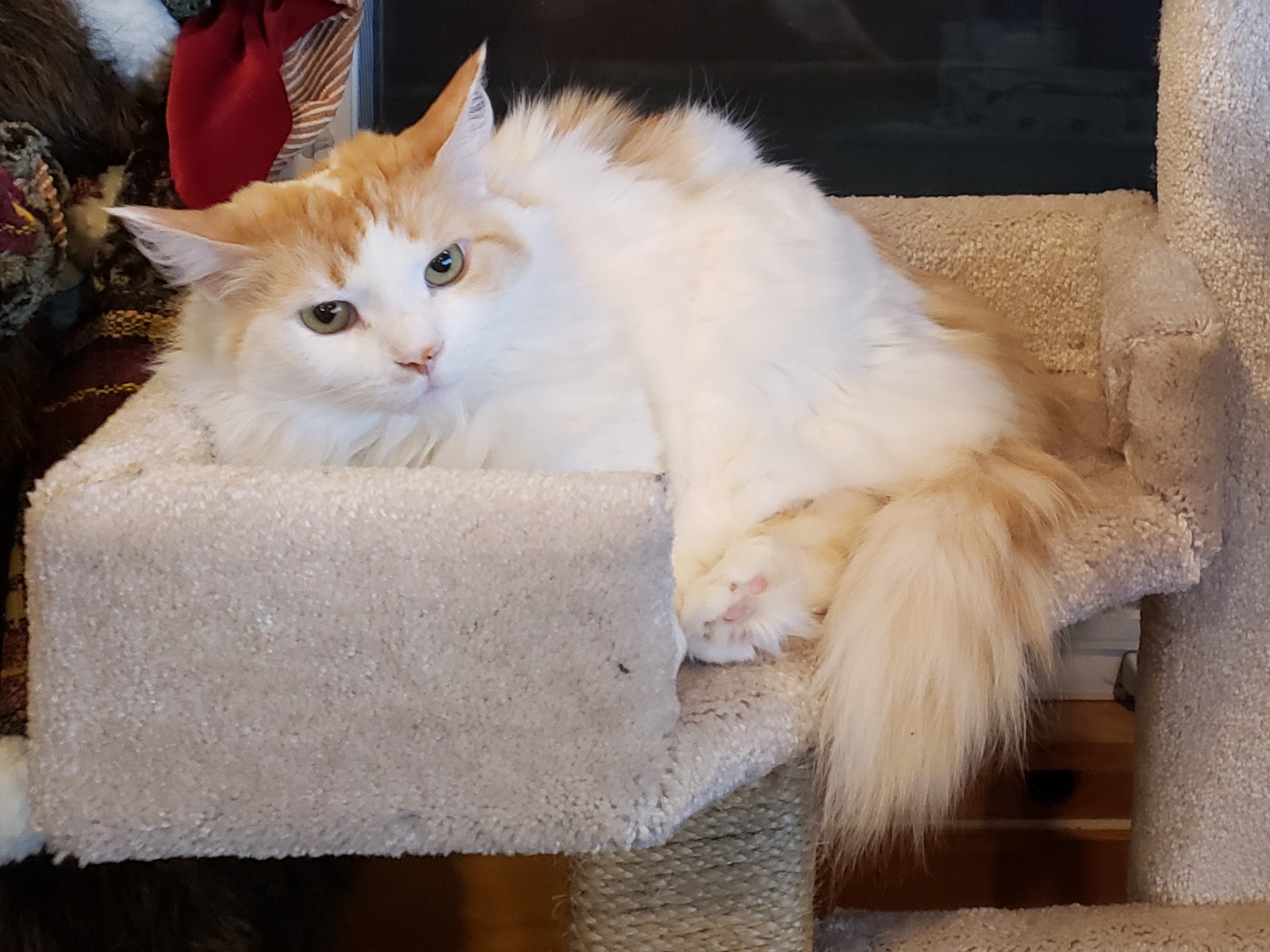
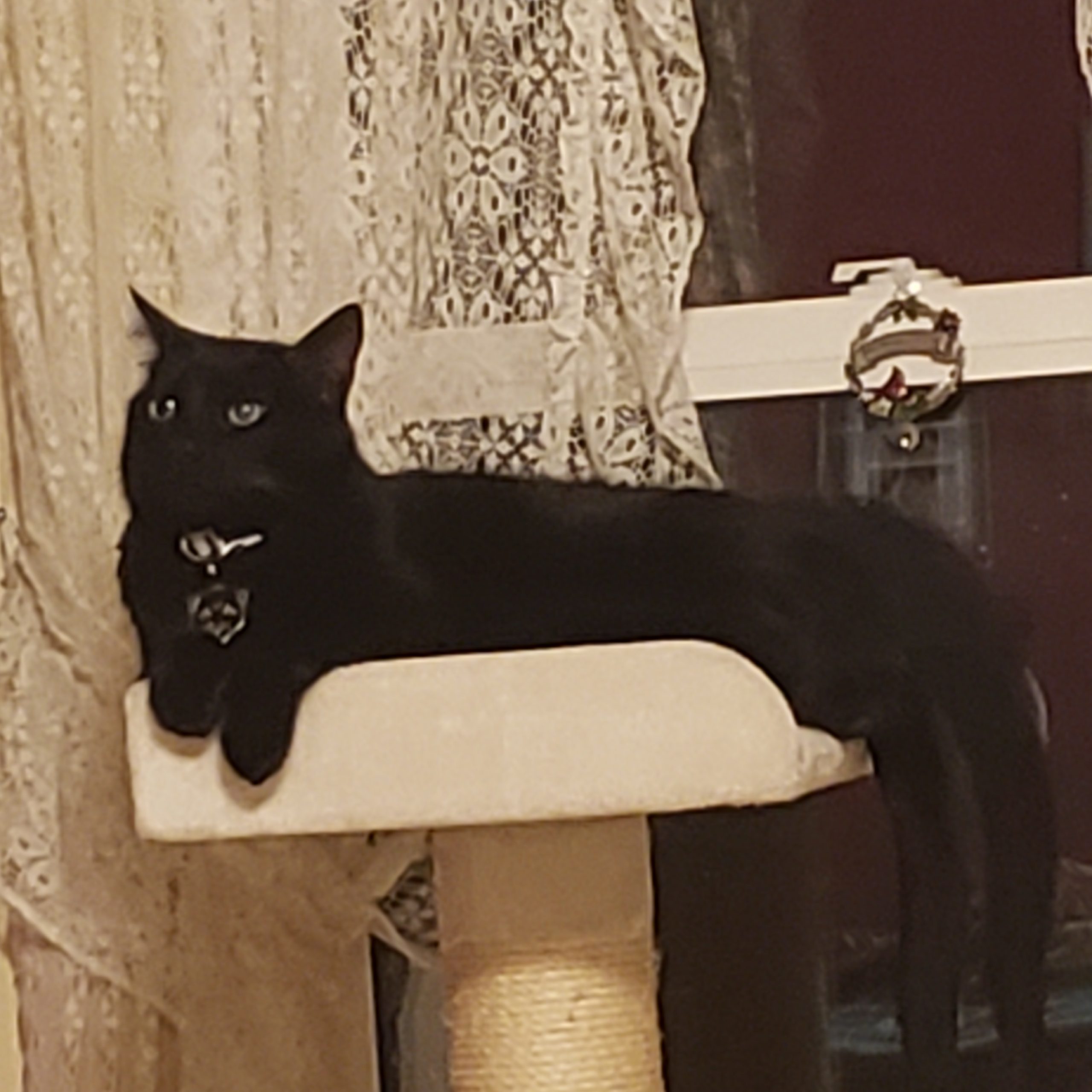
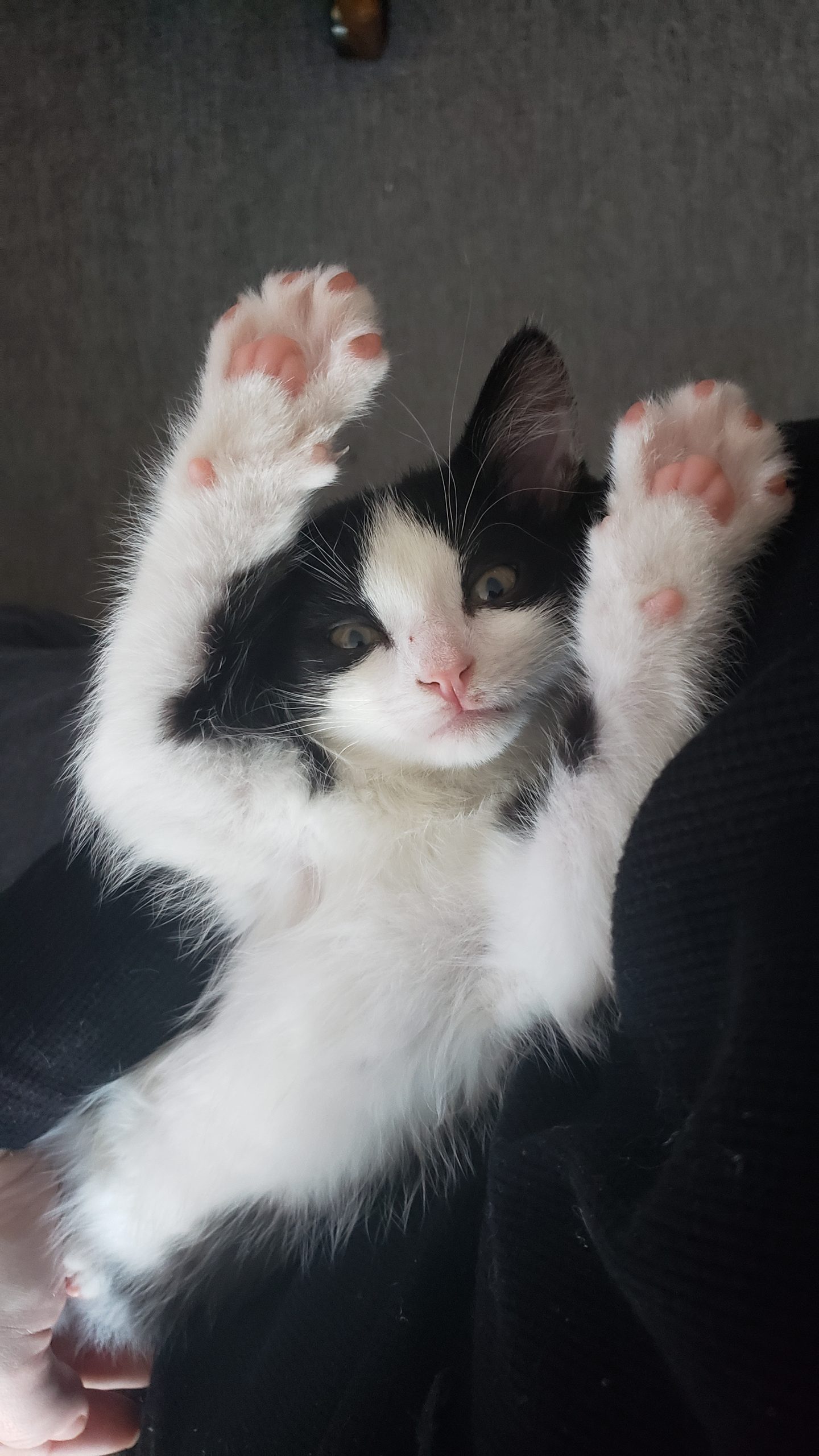
Cats exist in my working environment – Naomi the ninja, Miss Belle, Floofiest Of Her Name, and Gizmo, the new kitten.
What are your superpowers? This includes things you like your creations, specific techniques you do well, and some favorite successes.
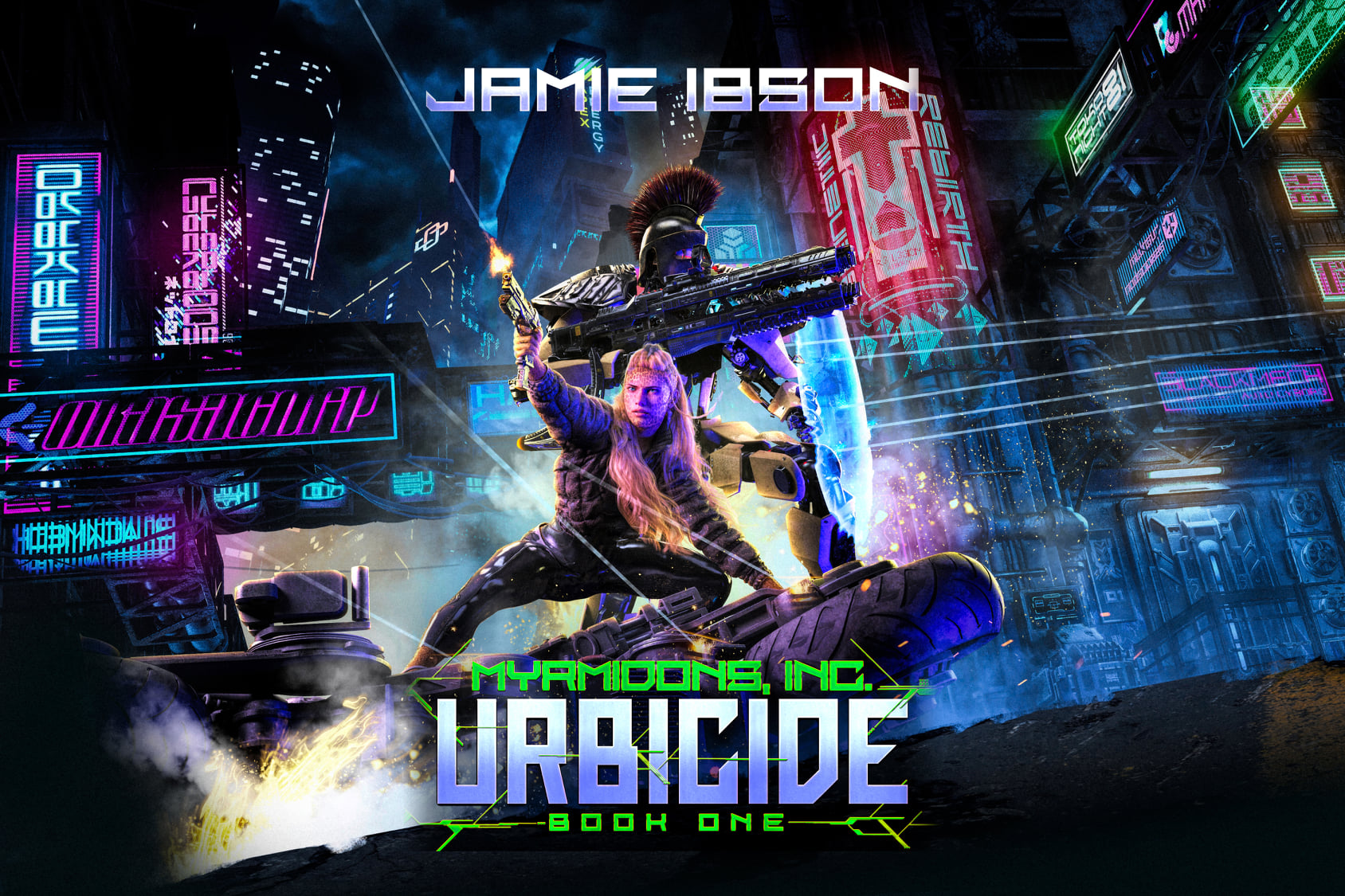
I like lots of different cultures in my writing. I currently plan to put each of the four (five?) Myrmidons books on a different planet with a different… Terran Ancestry, if you will. Urbicide was set on Montoya, in La Republica Del Escobar, which gave everything a distinctive South American Spanish tilt. Disavowed will be in & around the hive city of New Athens, in the Hellenic Cluster, so it’ll be Space Greek. Other destinations will include Space Russia, Space Japan, and probably Space Canada.
I think I do my combat scenes well. I’m 40, and since the age of 17 I’ve only had 1 year where I wasn’t wearing an infantryman’s uniform or a redcoat (ed.note: he’s Canadian, so by redcoat he means the RCMP).
I’ve been in fistfights, I’ve trained for firefights, I’m a good scrapper and good with a firearm. I try to keep my fight scenes tight and chaotic but accurate.
We Dares 1, 2, and 3
I’m very proud of the We Dare anthologies. Number Four is in the closing stages right now, and the feedback from them has been great, both from readers and from my contributors.
We Dare 1 was the first book with my name on the cover, and I had no idea what I was doing. Between them and last year’s And Then It Got Weird, I’ve edited more than 70 short stories, have generally had very good feedback from my contributors, and I think we’ve released a really great series of anthos featuring some really great authors.
What will Lex Luthor use to defeat you? This includes challenges you’ve faced that frustrated you, learning experiences, techniques for overcoming creative challenges, things you’d have done differently, and advice for new writers.
Hah, I am my own Lex Luthor. I struggle with self-doubt, anxiety, impostor syndrome, and have trouble focusing. So I’m not as productive, word-count wise, as I’d like to be.
Speaking of cats…
Sometimes, some very rare times, I can focus like a laser and I can bang off 4000+ words in a night. Others I’m like a cat chasing a disco-ball’s worth of little red laser lights and I’m so scattered as to be useless.
I wouldn’t say failures, so much as sticking points where I’ve gotten jammed up. And in those cases, I have some pretty great friends I can go to with a problem and say “So… how about this?” and they’ll say “Oh, do that” and boom, they can see to the heart of the issue pretty much immediately. I have really smart friends.
I overcome slow points a number of ways. Grind through, sprint, dictate, change the subject… curse Lex Luthor and his inability to focus…
Urbicide
I’d tell new writers, when getting going, find something you want to create for yourself and focus on it like a laser.
To date, I’ve written one 4HU novel co-written with Jason Cordova, another with Casey Moores, one in Christopher Woods’ Fallen World, and Myrmidons Inc: Urbicide. Getting going as a noob is difficult and I likely would have enjoyed greater sales and success if I had, say, written three Myrmidons books first before branching off in some other direction.
Lightning Round
Actor/Actress You’d Like to Play Any Character You’ve Created: Brendan Fraser to voice Bellerophon. He’s brilliant in Doom Patrol and I love him to pieces
Favorite Muppet? Pepe
Belle
Favorite Musical Performer We’ve Never Heard Of? Bill McClintock. (Check out his “Slipshack” mashup of Slipknot and the B-52s, it’s wild)
Winter, Spring, Summer, or Fall? Summer, because we live in the Maritimes now and I have a 9’ pile of snow in my back yard.
Favorite Superhero? Wolverine
Best Game Ever? Horizon Zero Dawn
Favorite 1970s TV show? Lol, I dunno man I was born in 81 and the cartoons I grew up on were pretty great…
Do You Have Pets? Naomi, Miss Belle, and Gizmo.Favorite Weird Color? Michelle has a gorgeous Victorian gown made out of a… I think it’s called taffeta, where it shimmers between brown and green. The effect is amazing.
Best Present You’ve Ever Received? Michelle gave me a pen as I embarked on my writing journey that simply says “Believe” on it. (See Lex Luthor weaknesses above for why that’s relevant)
Favorite Sports Team? Team Canada Hockey at the winter olympics
What Cartoon Character Are You? Optimus Prime
Your Wrestler Name? The Frozen Hoser
Your Signature Wrestling Move? The Avalanche
Naomi
What Do You Secretly Plot? [Redacted]
How Will You Conquer the World? [Still Redacted but nice try]
Best Thing From the 80s? Weird Al Yankovic, and/or Saturday Morning Cartoons
Favorite Historical Period? The Renaissance. People had style.
Person In History (Living or Dead) You Want To Hang Out With? Robert Heinlein
Steak Temperature? Medium Rare, I guess? I’m not really a steak guy, I prefer BBQ and burgers and pulled pork carnitas and tacos.
Favorite Chip Dip? Ranch
Beverage(s) of Choice? Homemade Nuka Cola with Baron Samedi spiced rum
What Actor or Actress Should Portray You in Your Biopic? Bruce Willis from like, 30 years ago
What Question Should I Add to the Lightning Round? Rock, Paper, or Scissors? (ed. note: Me like rock!)
What question(s) would you like to ask me?
Of all the stories you’ve published, which one is your personal favorite and why?
Rob’s Answer: So. I gotta pick between my babies? Yeeesh.
My favorite might be either the first or the third of the stories I gave James Young for the Phases of Mars.
More Gizmo, because who doesn’t want more kitten pictures?
The first story is the only time the Muse hit me over the head with a Clue-by-4. I literally can tell you only that it was set in 1908 and nothing else, or it gives the story away. The key to that is the final word, which I used only once in the story, though James quite rightly initially pushed for me to use it throughout as editor.
The third was the only story I’ve written in the time period I’ve actually studied, Anglo-Saxon England. It was a retelling of the Battle of Maldon, with some reconsideration of Byhrtnoth’s “ofermod” and the strategic challenges he faced. Oh, and there’s a plausible way the English could have won.
I could say the story I sent to Jamie for We Dare, but that’s mostly because of the story about the story, which he and I still tell. Just give us a beverage…
There’s the story I gave to Kevin Steverson for his Salvage Title Universe that was totally written to be quirky and fun. Putting in 227 band name and song name references in a short story was a great challenge.
The Ravening of Wolves, frankly the whole Foresters series, proved to me I could do this job.
I’ve skipped over a bunch, and each of them has a particular reason for being precious to me.
I think, though, I have to say A Lake Most Deep. Yes, it’s my first book and it’s flawed for many of the common first book reasons. But I wrote it in a really down place in my life, and I’m not entirely sure where I’d be or even if I’d be if I hadn’t written it.
Next releases include Keen Edge of Valor, and We Dare: Wanted, Dead or Alive
And where can we find you?
Conventions are on hold until we can cross into the USA without needing to invest in covid tests. Generally speaking, I go to LibertyCon, went to FactoryCon last October, and hope to attend FantaScis, Superstars, and maybe LTUEs going forward? We’ll see, that’s a lot of travel from the frigid north.
Do you have a creator biography?
Jamie Ibson is from the frozen wastelands of Canuckistan, where moose, bears, and geese battle for domination among the hockey rinks, igloos, and Tim Hortons. After joining the Canadian army reserves in high school, he spent half of 2001 in Bosnia as a peacekeeper and came home shortly after 9/11 with a deep sense of foreboding. After graduating college, he landed a job in law enforcement and was posted to the left coast from 2007 to 2021. He retired from law enforcement in early 2021 and moved clear across the country to write full time in the Maritimes. He is married to the lovely Michelle, and they have cats.
Final question for you: What should I have asked but did not?
What are you doing now, that much-younger-you never would have guessed you’d love?
(Me, cooking/turning into a foodie)
Rob’s Answer: Oooh, great question. For me, it might actually be writing itself. I started this job at 46, having never really written anything other than academic stuff, having never really done anything creative. I didn’t think I could.
Name two of your most-favorite niche genres, whether that’s within SF or Fantasy or Other…
(Examples: Cyberpunk SF, noir mystery, First Contact SF, military fantasy)
Rob’s Answer: Noir/hard-boiled mystery is probably the genre that fits into everything I write, no matter the other genre.
* * * * *
What a fun interview. Many thanks for Jamie fighting through the helpful assistance of his cats and providing me this to share.
For the first quarter of 2020, my Wednesday interviews will be with authors who are part of When Valor Must Hold, the upcoming anthology of fantasy stories published by Chris Kennedy Publishing.
This week’s interview is with Bill Webb, whose story “Island of Bones” is good old-fashioned pulp fantasy. Heroes, ancient evils, horrifying monsters. All the good stuff.
Interview: Bill Webb
Why are you here?
What are your influences? I’m heavily influenced by history, even in my fiction. At the end of the day stories are about characters, and most of my characters are humans. Since human nature is unchanging, and it is, the fun part becomes using those personality types in a new setting.For example, at its heart my series The Last Brigade is about the power of the individual to affect great events. This theme carries through in other stories like The Sting of Fate and The Moles of Vienna.
Who are some favorite other creators? That’s a very long list. Robert E. Howard, Michael Moorcock, Roger Zelazny, Robert A. Heinlein, Karl Edward Wagner, all writers in the Four Horsemen Universe, John Babb, Fritz Leiber, Michael Connelly, Randy Wayne White…the list is nearly endless.
What made you a creator in the first place? It was probably the desire to emulate what I liked. I still have a ‘comic book’ that I started one day during High School Spanish class. I had colored pencils and everything, and drew it on ruled paper. My earliest known fiction story grew as a direct result of reading Fritz Leiber’s Fafhrd and the Gray Mouser’ tales.But the actual compulsion to create came from somewhere out in the ether. I’m probably the worst person to guess what that means, because I have no idea why I first felt the need to share stories. Maybe I’m an insecure showoff who needs the validation of others to feel good about myself, or maybe I just like the idea of creating something new. If either one of those is true, I’m not the one to tell you which it is, because I don’t know.
Why did you choose to create what you create? I’ve always thought the things I create chose me, but I guess there are lots of my creations jumping around and waving for my attention like children. And by writing a particular story, I’m choosing which one to pay attention to…okay then.It’s all very random. As a diehard pantser I always only start with a vague idea, and it’s always whatever seems appropriate at the moment. Oddly enough I do plan out which books I’m going to write when, so in that regard planning is important to me. But the actual creative process is about as haphazard as it gets.My rewrites almost always add substantial words to my first draft, so the choice of what to include and what not to lasts far beyond the point it does for most writers. In my experience, most writers pare down their first draft instead of expanding it.
What would you like to create someday? An alternate WW2 history series is one thing I want to create, which is actually coming later this year. I also would love to create an alternate Civil War series, Punic War series…and a space novel that I would really like to fit into the Four Horsemen Universe, but so far haven’t been able to make that work.
Describe your great Lab of Creation?
Where do you work? Home? Coffee Shop? Home. I can work elsewhere, but I’m usually not as good at producing things. My office is a disaster, there’s paper everywhere, books, the usual detritus of a writer, and my desk has coffee stains everywhere. One limiting factor for me is that laptop keywords are too small for my hands, so I keep hitting the wrong keys.
Do you listen to music? Yes, 99% of the time it’s hard rock, and 95% of that time it’s my favorite band, Status Quo, or bands that grew out of Status Quo’s example, such as Piledriver or Predatür.
What other things exist in your productive environment? A TV. When not listening to music, the TV is on. I get some of my best dialogue from Jerry Springer. (Truth)
What things have you tried that haven’t worked? Outlining. If it works for other writers, God bless ‘em, but it sure doesn’t work for me.
What are your superpowers?
What kinds of things do you like in your creations? Everything I write has some element of the power of the individual to affect events far beyond the scope of what one person can generally be thought to influence. I also love to play around with the role that Fate plays in great historical events. The Sting of Fate, for example, posits the difference that one wasp could have played on the history of the world, had it used its stinger at a critical moment.
What are specific techniques you do well? Some would argue, there are none. But I think I do a good job of putting my readers into the moment. I am often told by readers they can picture what I’m describing perfectly, despite the fact that I live by Roger Zelazny’s dictum of never using more than two descriptors. I’ve also become pretty adept at tell a scene, battles in particular, from various POVs.
What are some favorite successes you’ve achieved, especially things you had to struggle to overcome? The way I was taught to write was my biggest obstacle, the one that took decades to purge. Being more or less a Creative Writing major in college, I learned how to write literary fiction. My teachers wanted me to emulate Faulkner, or James Joyce, and the word ‘genre’ might earn you an ‘F.’ I did learn to write beautiful sentences, but they went nowhere because the prose was the point, not the story. Out of sheer frustration I quit writing fiction in 1996 and didn’t try it again until 2014. By then I had gotten out of the habit of ignoring story and was able to write prose that people actually enjoyed.
What will Lex Luthor use to defeat you?
What are some of the challenges you have faced that frustrated you? Trying to get an agent. The whole process is backward and ridiculous. Fortunately, I figured out that the whole concept of an agent is no longer important to me, or any writer that’s paying attention.
Do you have any creative failures which taught you something? What were those lessons? Boy do I. Whole filing cabinets full of them. I have one novel in which I combined hard SF with sword and sorcery. The concept isn’t impossible to pull off, some have done so, but it’s hard. I took this novel to a small press, this was in the 1980s, and they agreed to publish it, even naming an amount for an advance. But editor wanted me to expand a 70k word book to 120k. Keep in mind, this was before computers, so everything was written on a typewriter.I did it. It took two years, but I did it. However, I had not insisted on a contract, and when I finished the editor told me they weren’t publishing fiction anymore. He couldn’t pick up an phone and call me, even though we lived in the same city, he let me work for two years first.Needless to say, the bloated book read like a bloated book. I have since reused parts of it, but there are literally thousands of edited pages of that book still in my possession.
How do you overcome normal slow points like writer’s block?I have two methods. First, I don’t believe in writer’s block, I think that’s an excuse. It is for me, anyway. So if I get stuck at point, I either write another sentence no matter how bad it might be, and keep writing until the story starts flowing again, or I jump to a different scene and write that.If neither one of those works, I go to something different. It’s not unusual for me to work on 3 or 4 different projects in the same day.
Which mistake would you try to keep other creators from making? Wasting time trying to get an agent so you can publish traditionally. The whole thing has become a farce. There are agents who actually charge for you to pitch to them at a conference. That’s indefensible.
If you could go back and tell yourself anything about writing, what would it be? Listen to your own instincts. Attend writing classes, conferences, conventions and seminars, but write the way you like to read.
Lightning Round
Favorite Muppet? Miss Piggy.
Favorite Musical Performer We’ve Never Heard Of? Status Quo.
Favorite Superhero? Ben Grimm.
Favorite 1970s TV show? The first season of MASH. Marcia Strassman was hot.
Favorite Weird Color? Teal.
Favorite Sports Team? Memphis Tigers.
Best Game Ever? Chess.
Winter, Spring, Summer, or Fall? Summer.
Best Present You’ve Ever Received? It’s X-rated.
What Cartoon Character Are You? Johnny Quest.
Your Wrestler Name? Wham-wham William.
Your Signature Wrestling Move? Pulling a Colt 1911.
What Do You Secretly Plot? To buy Jamaica.
How Will You Conquer the World? In my dreams.
Best Thing From the 80s? My kids.
Favorite Historical Period? World War Two.
Most Interesting Person In History? Winston Churchill.
Steak Temperature? Medium well.
Favorite Chip Dip? French onion.
Favorite Cereal? Raisin Bran.
What Do You Eat For Your Last Meal? Bacon cheeseburger with fries and chocolate shake.
Beverage(s) of Choice? Unleaded: Diet Pepsi. Leaded: mojito.
Do You Have Pets? Yes, seven dogs.
What Actor or Actress Should Portray You in Your Biopic? If we was younger, Donald Sutherland. I once got a free meal by pretending to be his brother.
What Question Should I Add to the Lightning Round? What book have you re-read the most?
What question(s) would you like to ask me?
What’s the best answer you’ve gotten to one of these interview questions?
Rob’s Answer: Probably Quincy Allen’s “Don’t let the naysayers win.” This isn’t an easy job, especially since it tests one’s confidence daily and we all deal with imposter syndrome. That’s the serious answer, but I’ll admit there’s been some fantastic Lightning Round answers. Those are often my favorites in a given interview.
Standing In Righteious Rage, The Last Brigade Book 5, is scheduled for release in early May. High Mountain Hunters, a planned book in the 4HU, should be delivered by mid-May. Also, I have agreed to a World War Two alternate history trilogy with Eric Flint’s Ring of Fire Press, titled A World Afire. It’s a great year for me to be stoked!
And where can we find you?
I’m a Special Guest at Tupelocon, the first weekend in March
Midsouthcon March 20-22
Libertycon in June
I’m also doing a signing at Fort Knox in July.
Do you have a creator biography?
Born and raised by a family of nomadic badgers in West Tennessee, Bill Webb wrote his first stories in grade school, terrifying all who knew him, and that was before he found comic books and science fiction. (He is still angry at having a copy of X-Men #53 ripped out of his hands during 11th grade Spanish class.)
The release in 2016 of his Last Brigade series changed his career path by actually giving him a career path. The Time Wars and Sharp Steel and High Adventure series’ soon followed.
By age 25 he’d read all of the classics…Robert E. Howard, Fritz Leiber, Robert Heinlein, Michael Moorcock and Roger Zelazny. Later influences include Larry Niven, Jerry Pournell and Larry Corriea. Indulging himself in a double concentration at the University of Memphis of Creative Writing and History, college felt more like a long party than school.
After multiple careers in various industries, he much prefers writing books and stories to any sort of actual work. His idea of punching a clock these days is a coffee maker that finishes brewing its magic five minutes before he gets up in the morning.
Snippet from Bill’s new fantasy story, titled Beyond the Dead River.
The crocodile wanted to submerge, but she pulled back on the reins and kept the tired reptile swimming. The thrusts of its powerful tail had slowed, as had its paddling feet, but her stance astride its back allowed direct use of the spurs on her bootheels to keep it moving forward. At last it reached the river’s far shore and hauled the entire enormity of its bulk onto the mud flat. Rolling out the tethering chain, she looped it around the bole of a giant tree and scanned both ways for potential predators.
The dense jungle didn’t intimidate her. Vines with thorns and thick, oval leaves hung from trees taller than a castle’s keep, while a nearby stream emptied into the muddy river. Despite her knowledge of the rain forest, the dense undergrowth and deepening twilight left her dreading the need to travel in darkness deeper than the perpetual shadows of the rain forest. Her nostrils flared as she sniffed a light breeze for the scent of any nearby predators, and one eye twitched at a musky smell she knew belonged to a python. She would have to be very careful.
She had the lean, muscular physique of a warrior. Her limbs didn’t have the soft curves of a city born woman, but instead had muscles that appeared roughly cut from stone. Yet no one could mistake her for being a man. She had chosen her raiment specifically for travel through in the jungle. She had tucked loose trousers of well-worked animal leather into calf-high boots of snake-skin, with a leather shirt stretched tight across her chest. Two longs knives hung from a simple belt around her waist. Thick, curly black hair fell past her shoulders, held in place by a rawhide thong. A stained, short-brimmed hat protected her head from the countless overhead threats that inhabited the country through which she had to pass to achieve her mission.
Thanks to Bill for taking the time to answer my questions.
If you have any suggestions or comments about this interview format, let me know so I can keep tweaking it.
Also, thanks to you for reading. If you’re interested in any of the other interviews I’ve done, you can find them all here: https://robhowell.org/blog/?cat=326. If you are a creator, especially an independent creator, and you want to be spotlighted in a future interview, email me at rob@robhowell.org.
Finally, if you want to join my mailing list, where I’ll announce every interview, as well as what’s going on in my life, go to www.robhowell.org and fill out the form (Name and Email Address) or drop me an email and I’ll add you.
For the first quarter of 2020, my Wednesday interviews will be with authors who are part of When Valor Must Hold, the upcoming anthology of fantasy stories published by Chris Kennedy Publishing.
This week, the interview is with Jon Osborne, who I think is a rising star. His story in When Valor Must Hold is called “The Errand” and you’ll love it.
Interview: Jon Osborne
Jon Osborne
Why are you here?
My early science fiction influences are Robert Heinlein, Isaac Asimov, Larry Niven, George Lucas, and Gene Roddenberry. My fantasy influences, which came later, were Charles de Lint, Randall Garrett, Steven Brust, and Gary Gygax. More contemporary inspiration comes from the likes of Eric Flint and Kevin Hearne.
I was a gamer before a writer. I started off as a Dungeon Master because I had the rules, and storytelling became addictive. I learned from an early age that characters will not do what you expect, nor do they care about your pre-conceived plans.
The Milesian Accords wasn’t a story that had been bouncing around for years. It coalesced while I was driving every week between Indianapolis and Chicago to deal with my parents’ estate. The beginning and ending of the story formed right away, and the rest filled in as I wrote the story.
Describe your great Lab of Creation?
I do 95% of my writing in my home office on a sprawling, cluttered desk. When I played MMOs, I spent the bulk of my time parked in front of this corner desk, and when I transitioned to writing, I remained parked here.
I use YouTube for my background music. By and large, I listen to soundtracks. The most notable exception is the Mongolian heavy metal band The HU, and the funk band Here Come The Mummies.
I’m not a coffee drinker, so the coffee shop doesn’t hold an appeal for me. I’d rather have a whisky or beer in the comfort of my home rather than sit in an establishment full of strangers.
What are your superpowers?
Based on feedback, it appears I do dialogue well. Disney, if you’re reading this, I can help you out with that next Star Wars movie – you need it. I like to think I’m good at world-building – although my editors might say I get carried away – another trait from my background as a game master.
One of the things I had to overcome was my training – I majored in journalism in college, so I was taught to keep sentences short and my writing concise. Once I tried my hand at descriptive fiction, I found out I sucked at complex sentences – especially commas use. The way it sounded in my head was the opposite of how I should write. Fortunately, my publisher was a great mentor and patient with me.
What will Lex Luthor use to defeat you?
Superman has kryptonite, and I have squirrels. Staying focused is a huge challenge for me. In fact, I’m filling this out when I should be finishing a book. I’ve found I should keep my phone out of arm’s reach, as a quick checking of e-mail or social media turns into half an hour.
One thing I regret was never learning to type. Despite majoring in journalism in high school and college, I didn’t take typing classes. I mostly use my index fingers. If I typed faster, maybe I could keep up with my brain.
Lightning Round
Favorite Muppet? Animal
Favorite Musical Performer We’ve Never Heard Of? The Hu
Favorite Superhero? Wolverine
Favorite 1970s TV show? Battlestar Galactica
Favorite Weird Color? 633fcc
Favorite Sports Team? The Colts
Best Game Ever? D&D
Winter, Spring, Summer, or Fall? Fall
Best Present You’ve Ever Received? When I found my missing cat on Christmas Day
What Cartoon Character Are You? Scooby Doo
What Do You Secretly Plot? A 6 book RPG Lit series
How Will You Conquer the World? Sounds like too much work
Best Thing From the 80s? You expect me to pick one? Those were my high school and college years.
Favorite Historical Period? It depends on what Wikipedia page I’m looking at.
Most Interesting Person In History? See above.
Steak Temperature? Medium
Favorite Chip Dip? Nacho cheese
Favorite Cereal? Captain Crunch Peanut Butter Crunch (but it’s like eating peanut butter flavored gravel and will shred your mouth)
What Do You Eat For Your Last Meal? A bacon-wrapped fillet, french fries, and chili at the Ale Emporium
Beverage(s) of Choice? Beer
Do You Have Pets? No
What Question Should I Add to the Lightning Round? If you wrote under a (different) pen name, what would it be?
What question(s) would you like to ask me? What was the hardest book/story to write and why?
Rob’s Answer: So far, that clearly has to be None Call Me Mother. I’ve been working on it for two years now, and it still isn’t done. I’m getting close, but man this one hasn’t gone smoothly.
Jon R. Osborne is a veteran gamemaster and journalism major turned science fiction and fantasy author. The second book in the Jon’s The Milesian Accords modern fantasy trilogy, “A Tempered Warrior”, was a 2018 Dragon Awards finalist for Best Fantasy Novel. Jon is also a core author in the military science fiction Four Horseman Universe, where he was first published in 2017.
Jon resides in Indianapolis, where he plays role-playing games, writes science fiction and fantasy, and lives the nerd life. You can find out more at jonrosborne.com and at https://www.facebook.com/jonrosborne.
Thanks to Jon for taking the time to answer my questions.
If you have any suggestions or comments about this interview format, let me know so I can keep tweaking it.
Also, thanks to you for reading. If you’re interested in any of the other interviews I’ve done, you can find them all here: https://robhowell.org/blog/?cat=326. If you are a creator, especially an independent creator, and you want to be spotlighted in a future interview, email me at rob@robhowell.org.
Finally, if you want to join my mailing list, where I’ll announce every interview, as well as what’s going on in my life, go to www.robhowell.org and fill out the form (Name and Email Address) or drop me an email and I’ll add you.
For the first quarter of 2020, my Wednesday interviews will be with authors who are part of When Valor Must Hold, the upcoming anthology of fantasy stories published by Chris Kennedy Publishing.
This week’s interview comes from Quincy J. Allen, a fantastic author who’s already made a name for himself though I think he’s still a rising star. His story is a Fistful of Silver, set in his Guardians of Pelinon universe, and it’s something as if Raymond Chandler wrote Sparhawk instead of David Eddings. Needless to say, I loved it.
Interview: QJ Allen
QJ Allen
Why are you here?
What are your influences?
Jullian May, Robert Heinlein, Roger Zelazny, Keith Laumer, Jack Chalker, Kenneth C. Flint, Poul Anderson, Steven Brust
Who are some favorite other creators?
Katsuhiro Otomo (Akira), Ridley Scott (Blade Runner), Frank Herbert (Dune), Olaf Stapledon (Last and First Men), Gene Roddenberry (Star Trek), Jon Favreau (EVERYTHING)
What made you a creator in the first place?
Seriously, though, I wrote my first fiction story in the 3rd or 4th grade. I’ve always written. Writing got me through primary, secondary, Bachelors, and Masters education. It was always there in every professional job I ever had. And when I got RIFed in 2009, it made more sense to just try and be a professional writer.
Why did you choose to create what you create?
As a boy, I read the Jupiter Jones mysteries and loved them. A few years later, my older brother handed me his copy of “The Science Fiction Hall of Fame,” and I was hooked. There was no going back, and I devoured science fiction and sci-fi crossed with others from there on out. I read fantasy, but my staple was science fiction. When I discovered Julian May’s “The Many Colored Land” series, which is pure cross genre between sci-fi and fantasy, I truly fell in love. So, I’ve written what I love as much as possible.
What would someday like to create.
The entire Blood War Chronicles series of six books is a setup so that I can write Skeeter’s story as a 30-year-old airship privateer captain gunslinger sorceress engineer. So, that will be a thing. I also plan on writing a three-book series set in that same universe that connects the three great fires of the 19th century via a Jesuit witch/demon hunter. I’ll be writing a powered armor series as well as a new fantasy series involving druids. But I have to get my current commitments behind me, and that’s no mean feat.
Blood War Cover
Describe your great Lab of Creation?
Where do you work? Home? Coffee Shop?
I take my laptop everywhere when I travel with my wife. She travels for her job, so I sometimes get to tag along for free trips. She has mad hotel and airline points. My actual workspace, however, is in our two story shop in the back yard. It triples as her sewing room, my actual work shop for carpentry, repairs, leather working, and whatnot, as well as a three-monitor workstation where I used to also run a small book design and author collateral marketing business. I spend most of my waking time out in a shop so I can open the doors in the summer and use the kerosene heater in the winter.
Do you listen to music? If so, give some examples.
I’ve never been able to work without music. It drove my old man crazy when I was a kid, but that part wasn’t negotiable. The first thing I do when I get into the shop is fire up Pandora. As to my music tastes, they’re more expansive than anyone I’ve ever met, and they can be quite eclectic. On any give day, you can hear Pentatonix, Joe Bonamassa, The Hu (Mongolian death metal), Steely Dan, Steam Powered Giraffe, Bach, Mozart, Five Finger Death Punch, electronica, daft punk, techno, Celtic—pretty much everything except modern country twang and most rap. Those two are a hard no, Bob.
What other things exist in your productive environment?
Cigars and my tobacco pipe. I work better with them. Oh, and COFFEE. Always coffee in the morning. And whenever I can manage it, fresh air and the sound of birds. Our house is surrounded by trees here in North Carolina. I come from Colorado, where there aren’t many trees until you get to the mountains. Here, it’s pretty much a friggin bird sanctuary, and I love it. It’s one of my favorite parts of the Carolinas.
What things have you tried that haven’t worked?
Romance writing, for one. I don’t have a knack for literary fiction either. That stuff bores the shit out of me. I’ve written variations on just about all of the genres, however. Science fiction, mystery, noir, fantasy, steampunk, horror, speculative… most of my stories mix at least two of those.
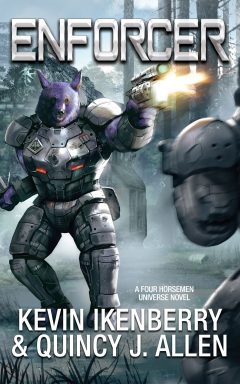
Enforcer Cover
What are your superpowers?
What kinds of things do you like in your creations?
I’ve been told (and I agree) that I do three things fairly well. Fight scenes, dialogue, and descriptions. I’ve also been honing my skills with world building, and I think I’ve finally gotten pretty good at that. If I had to pick one, though, it would probably be hand-to-hand fight scenes. I used to train in martial arts pretty heavily, even with a marine and a Green Beret. I can see a fight in my head, and that seems to translate pretty well to the written word. That’s the rumor, at least.
What are specific techniques you do well?
I’ve done it on three separate instances, and in all of them, the process was smooth and the output worth the effort. I’ve gotten pretty good at outlining as a result of those projects, although my outlines become a mix of bullet points and dialogue. I’ve also gotten pretty good at popping up prose with a more active voice. There are hiccups from time to time, but I’ve mostly broken myself of the passive voice devil.
What are some favorite successes you’ve achieved, especially things you had to struggle to overcome?
One certainly was passive voice. Also, as a result of working with Marc Edelheit, I’ve gotten much better at flowing from one scene into the next. Looking back, I think there were pieces of a story that I skipped over. The result wasn’t jarring, per se, but what I’m doing now is much smoother as one reads through my prose. Also, I think I’ve gotten at least competent as capturing a single, targeted emotion that I want the reader to experience by the end of a story. Most of the time, especially in my short fiction, I strive to make the reader “feel” something very specific. Be it honor or sacrifice or duty or whatever, I’ve learned to write entire stories so that most of the prose leads to that experience.
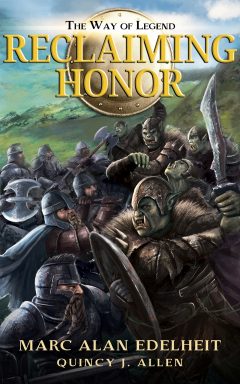
Reclaiming Honor Cover
What will Lex Luthor use to defeat you?
What are some of the challenges you have faced that frustrated you?
The first is sticking with a writing career when sales are lackluster or even worse. A perfect example is the Blood War Chronicles. They’re good books, with good reviews, but they haven’t created the revenue stream I’d hoped for. In fact, I’ve been at this game for ten—make that eleven—years now, and I can’t say that I earn a living with my writing. I think that’s the hardest part for most writers: sticking with this game even when you’re not selling. I often joke with a writer friend of mine, Aaron Ritchey, about how we’re “living the dream.” But that dream is the joke. We keep writing, we keep not selling the way we would like, and yet we keep writing. I think the other is that I’m really proud of at least a few short stories (Family Heirloom, Salting Dogwood, Jimmy Krinklepot and the White Rebels of Hayberry, and a few others, that I think are exceptional short stories, but they’ve never really been acknowledged for what I “think” they are. Granted, I have a bias, but I believe those stories are truly noteworthy.
Do you have any creative failures which taught you something? What were those lessons?
From a monetary perspective, I think you could call everything I ever wrote in the first nine years of my career (except one story I wrote for Larry Correia’s MHI franchise) as failures. None of them came close to providing an ROI on the time I’ve invested in them. However, that’s hasn’t slowed me down. And that’s the lesson, one I think most writers could learn from. If you keep going and keep getting better, eventually you’re bound to gain momentum. My work in recent years with Marc Edelheit, Kevin Ikenberry, and CKP are a testament to that. Last year and this year are seeing actual returns on my investment of time. The trick is to keep going and always hone your craft.
How do you overcome normal slow points like writer’s block?
I take Eric Flint’s advice. There is no writer’s block. You keep writing, because it’s your job. Either you are a writer and you write, or you’re a hobbyist who doesn’t want to earn a living at this mad career choice.
Which mistake would you try to keep other creators from making?
I’ve said this at cons and in panels dozens of times: “Don’t let the nay-sayers win.” I grew up hearing the phrase, “What? You want to be a starving artist the rest of your life.” As a young man, I listened to this “advice.” If I had started in earnest at 20 what I ended up starting at 43, I’d already be earning a living at this game. It just takes time and determination, so long as you keep getting better. So, to any writer who hears/reads this, when someone questions your desire to become a writer, just tell them to fuck off. Keep going, make sure your bills are paid, keep your bills low, and DON’T QUIT.
If you could go back and tell yourself anything about writing, what would it be?
See above. That’s the best advice anyone in this crazy game could receive. Writers have enough doubt and imposter syndrome without getting it from outside sources. Find ways to kick the nay-sayers to the curb.
Lightning Round
Favorite Muppet? Animal, of course. Oh, and Sam the Eagle.
Favorite Musical Performer We’ve Never Heard Of? Ian Moore and Joe Bonamassa.
Favorite Superhero? Both the Punisher and Deadpool in a perfect tie.
Favorite 1970s TV show? Monty Python
Favorite Weird Color? Teal
Favorite Sports Team? Sidney Swans
Best Game Ever? Halo, OF COURSE. That and Mass Effect.
Winter, Spring, Summer, or Fall? I fucking HATE snow and delight when it dies.
Best Present You’ve Ever Received? My 2016 Moto Guzzi Audace. Vicki got that for me for my birthday last year. Nothing else compares.
What Cartoon Character Are You? Did they make Roy Batty into a cartoon? If so, him. If not, I guess I’d have to say the dog Marc Antony in the old Warner Brother’s cartoon “Feed the Kitty.” Ask Vicki, she’ll tell you.
Your Wrestler Name? Wrath
Your Signature Wrestling Move? The Smash. A single fist to the crown of someone’s skull. REALLY hard.
What Do You Secretly Plot? Convincing Vicki that we need an AR-10 and a Marlin .357 lever action rifle in the house.
How Will You Conquer the World? By eliminating deceit everywhere.
Best Thing From the 80s? 11:59:50 pm on 12/31/1989 — the nightmare was over.
Favorite Historical Period? The Renaissance and dawn of looking to the stars as stars, not “the Heavens.”
Most Interesting Person In History? The alien that gave humans blue eyes.
Steak Temperature? Medium rare… or I’ll cut you.
Favorite Chip Dip? Really good 7-layer dip.
Favorite Cereal? As a kid, Honeycomb. Now, Honey Bunches of Oats topped with sliced peaches rather than milk.
What Do You Eat For Your Last Meal? Pad Thai made by Vicki’s son, and it was REALLY good. We’re all cooks around here.
Beverage(s) of Choice? Arnold Palmer, Costco flavored seltzer, Tennesee Mules, Margaritas, and COFFEE, lots of COFFEE.
Pachy
Do You Have Pets? He was Vicki’s dog before I moved in, but he’s my dog too, and he’s the best hound I’ve ever known.
What Actor or Actress Should Portray You in Your Biopic? Rutger Hauer when he was younger and not dead?
What Question Should I Add to the Lightning Round? Favorite food(s), nemesis, favorite vice, Commandments broken or Deadly Sins enjoyed.
Upcoming Projects: “Forging Destiny” – Book 2 of The Way of Legend with Marc Edelheit, “Scourge” – Book 2 of Hr’ent’s tale with Kevin Ikenberry, “Blood World” – Book 4 of The Blood War Chronicles, a Vorwhol novel for Kevin Steverson in his Salvage universe, and a novelization of the short story “Cradle and All” in Jamie Ibson’s universe.
And where can we find you?
ConCarolina
SAGA conference
LibertyCon
DragonCon
Do you have a creator biography?
National Bestselling Author Quincy J. Allen is a cross-genre author with a growing number of published novels under his belt. His media tie-in novel Colt the Outlander: Shadow of Ruin was a Scribe Award finalist in 2019, and his noir novel Chemical Burn was a Colorado Gold Award finalist in 2010.
Blood Oath, book 3 of his Blood War Chronicles series, debuted in February of 2019, and he is working on the fourth book in that six-book fantasy steampunk series, entitled Blood World, due out in 2020.
He co-authored the fantasy novel Reclaiming Honor with Marc Alan Edelheit in their Way of Legend series, released in October of 2019, and he is currently working on book 2 of that series. In November of 2019, he and Kevin Ikenberry published the novel Enforcer, which is set in the Four Horsemen Universe and is part of Ikenberry’s Peacemaker series. He is currently working on a novel for Kevin Steverson’s Salvage Title universe based upon the short story “Vorwhol Dishonor.”
His short story publications are numerous, including a pro sale appearing in Larry Correia’s Monster Hunter: Files from Baen, published in October of 2017 entitled “Sons of the Father,” as well as several pro-sale novelettes appearing in Chris Kennedy Publishing’s mil-sci-fi anthologies in and out of the Four Horsemen Universe. He also has two short story collections in his Out Through the Attic series, and he continues to add to his short-story credits with each passing year.
He works out of his home in Charlotte, North Carolina, and hopes to one day be a New York Times bestselling author.
Final question for you: What should I have asked but did not?
You should have asked if I only work alone or do I have a support mechanism? What keeps me going?
Then I’d answer that Vicki is my anchor and more supportive of my writing career than anyone else in my entire life.
Thanks to Quincy for taking the time to answer my questions.
If you have any suggestions or comments about this interview format, let me know so I can keep tweaking it.
Also, thanks to you for reading. If you’re interested in any of the other interviews I’ve done, you can find them all here: https://robhowell.org/blog/?cat=326. If you are a creator, especially an independent creator, and you want to be spotlighted in a future interview, email me at rob@robhowell.org.
Finally, if you want to join my mailing list, where I’ll announce every interview, as well as what’s going on in my life, go to www.robhowell.org and fill out the form (Name and Email Address) or drop me an email and I’ll add you.
For the first quarter of 2020, my Wednesday interviews will be with authors who are part of When Valor Must Hold, the upcoming anthology of fantasy stories published by Chris Kennedy Publishing.
Today’s interview is with Cedar Sanderson. Cedar is one of the first people who read my stuff. She and her husband read A Lake Most Deep and told me how much they liked the story. And how much they didn’t like the cover. Oh, the art was fine, but man, I had a lot to learn about title treatments and such-like things. She was very patient with me and has helped me a ton. That’s one reason I was so pleased to ask her if she wanted to be a part of When Valor Must Hold.
Another reason is that I’ve enjoyed reading her stuff. So, I was not surprised that I loved her story Goddess’s Tears. It’s an origin story of her Blood of Frost universe, where the hero pays a higher price than one expects to fight the evils around her.
Interview: Cedar Sanderson
Cedar Sanderson
Why are you here?
I started writing back when I was a teenager. I had actually forgotten about that until I found a partial manuscript – and house plans for the story! – recently. It’s pretty horrible. I think I was channeling Jo from Little Women. I know I started writing for two reasons: one, I ran out of reading material. Two, I’d always had worlds in my head and I was slowly convinced that other people would enjoy reading about them, too.
I started to read at a very tender age, so I don’t remember the first book I read. I can’t really choose a favorite author, either, because it changes so frequently, based on my moods. But I can say that I imprinted early on Heinlein, Edgar Rice Burroughs, Dorothy Sayers, and Louis L’Amour. Also, I happen to be named for a character in a novel, so I guess you could say that reading is in the blood. I write because I love to read.
I find myself drawn to, and writing, a lot of fantasy, which I find weird. I loved Tolkein and CS Lewis. Still do, for that matter. But I also find most modern High Fantasy almost intolerable with the tropes and the clichés and the stale pastiches, oh my. Urban Fantasy – Butcher, Correia, Briggs – can be very very good, but I had actually started to write it on my own before I was even introduced to them. I still find it weird, because all my life I wanted to be a scientist. So I should be writing science fiction. I do, and even my fantasy tends to have strong science elements in it. Still, fantasy is what calls the muse most strongly.
Describe your great Lab of Creation?
I work at home these days. For a year, I had a writing office where I went and there were no children, no distractions, just quiet and minimal writing supplies. I didn’t get a lot done there. I felt guilty not being at home taking care of the family. On the other hand, I tried putting my office out in the main part of the house in the theory that my family (three teens, a husband, and a dog) would not be constantly interrupting me if they had open access to me. That was a disaster. I stopped writing for months. It wasn’t until I started taking refuge in my bedroom with the door closed that I was able to focus and write again.
I use music to create mood. When I was writing Goddess’s Tears, I spent more time than I ought putting together the perfect playlist for it. If you’re curious, you can find that here: https://www.youtube.com/playlist?list=PL3V5Zg2dwDACe-V99XtclfNBqC4Fhkapf the title for the playlist is my working title for the story. Sometimes I can’t use music – recently when I have been bored at work I’ve been writing longhand in a notebook (shh… actually, no one cares. I’m still training in a new role and they know I’m unoccupied for a time). This seems to be working. The one creative nut I am trying to crack is dictation. I have an hour plus commute, and it seems I should use that time creatively but I get very self-conscious trying to speak the story aloud and compose on the fly. I’ll keep trying.
What are your superpowers?
I like to explore what it is to be human, and how far you can stretch that definition before it snaps. I really enjoy developing characters, and forging them in fires to bring out the true metal of their souls. Hence the working title of Goddess’s Tears, I was writing a story where the dross was driven out of a woman’s soul in the fires of hell itself. I’m told by reviewers and fans I do character driven stories very well. I’ve wondered at times if this means I don’t do action well, but I have also been told that in a couple of my books my pacing is ‘breathless’ which is, ok? I hope?
I rarely rewrite. I did with Goddess because Rob thought the story had some dross, and it was a great experience to go hammer and tongs with him on it. I think what we wrought is better than my first draft, and I’m delighted he spent the time on it with me. It was a learning experience. Rob’s Note: The story was always good, but I wanted more. And I got it.
What will Lex Luthor use to defeat you?
Oof. This is a difficult question to answer. I’m not going to get too deep with it.
The biggest challenge for me is that I have a career I enjoy very much, on top of the writing, and being an active artist. I’m busy – often too busy – and it’s frustrating to have ideas but no time to bring them to life. When I was still in college (the second time, almost 20 years after the first attempt) I was able to juggle classes, and write. But now that I’m a full time chemist, I come home drained. That, and teenagers are almost as hard as toddlers. I thought they’d be more independent, but nope!
I have several manuscripts in various states of completion. I’m struggling to finish any of them. The problem with some is that it’s been too long since I worked on it last, and I’d have to re-read it before I could start fresh. With 70,000 words on one (another Underhill book) that’s a daunting task. And I blocked on it for a reason, so I have to unpick where I went wrong and correct that. I’m a pantser. If I try to outline, I lose the story. So my recommendation is to plow ahead on a project and finish it. Don’t set it aside and come back months later scratching your head and wondering where you were going with that. Or abandon it entirely and call it practice. I’m too stubborn to do that last.
Lightning Round
Favorite Muppet? Beaker
Favorite Musical Performer We’ve Never Heard Of? Dead South
Favorite Superhero? Captain America
Favorite 1970s TV show? I grew up without television. I’m not sure what was on in the 70s.
Favorite Weird Color? Chartreuse
Favorite Sports Team? I don’t watch sports?
Best Game Ever? Oh, I really like Fluxx, with all the variations. There’s a Chemistry version!
Winter, Spring, Summer, or Fall? Spring
Best Present You’ve Ever Received? A friend and fan sent me several fountain pens. So wonderful for drawing!
What Cartoon Character Are You? Jessica Rabbit
Your Wrestler Name? La Bunuela!
Your Signature Wrestling Move? Boiling oil pour
What Do You Secretly Plot? How to go back to graduate school.
How Will You Conquer the World? Bake it cookies and lull it before… but I say too much.
Best Thing From the 80s? Die Hard
Favorite Historical Period? 1940s (WWII era)
Most Interesting Person In History? Dmitri Mendeleev
Steak Temperature? Blue
Favorite Chip Dip? Bacon Horseradish
Favorite Cereal? Steel-cut Oats
What Do You Eat For Your Last Meal? Chicken and Dumplings
Beverage(s) of Choice? Soda? Diet Dr. Pepper. Stimulant? Mead, preferably cherry mead.
Do You Have Pets? We have a dog, Tricksy, and two cats who are living with our daughter but were my office cats, Addie and Evie.
What Actor or Actress Should Portray You in Your Biopic? Scarlett Johansson
What Question Should I Add to the Lightning Round? Ask about favorite food or thing to cook!
What question(s) would you like to ask me?
So other than Butter Tarts, what are your favorite foods?
Rob’s Answer: Steak (medium rare, blackened, with garlic butter), Butter Chicken, fresh bread with butter and honey, biscuits and gravy (having already buttered the biscuits), and, uhhhh, butter, I guess?
When you write, do you share the story with anyone? I often use alpha readers when I get stuck on something.
Rob’s Answer: I think you have to at some point. It’s almost impossible for me to really judge what I’m writing. I mean, I know I like it, but I don’t know if anyone else will. I will say one of the best compliments I’ve ever had is when James Young said something like, “I know it’ll be good. It’s you.” That’s an awesome thing to hear, but I don’t believe it until someone else has given me honest input.
When you get discouraged, how do you cheer yourself up?
Rob’s Answer: Hmmm. This is a tough one, because I don’t always have a good answer here. I feel better anytime I complete something, even if it’s just the dishes. Procrasticleaning is a thing, y’all. It’s the days I go to bed having not accomplished anything that bug me, so I guess my answer is to finish a thing. Oddly, I can say that here, but I don’t necessarily think about it when I need to.
My latest novel is Possum Creek Massacre, a paranormal police procedural set in the Appalachians. The stories are drawn from family and true crime and my own forensic studies. https://www.amazon.com/gp/product/B07SQNLMPP
I’m working with my writing group on a weekly prompt challenge. You give a prompt, and are randomly assigned one in return. It’s a ton of fun, and a great way to get writing if you are having trouble gaining momentum. I started doing the group, and the challenge, as a way to give back to the community. Paying it forward for all those who have encouraged me or poked and prodded me along the way. If anyone wants to play along, check it out here: https://moreoddsthanends.home.blog/
And where can we find you?
I’m not planning any event appearances in 2020. I’ll be attending MarCon as a guest, incognito with family. I’ll be taking my kids to GemCity ComicCon, and probably the same for CincyComiCon as well. Happy to meet up if you happen to be there!
Do you have a creator biography?
Cedar Sanderson is an author, artist, and a scientist. Her varied career lends extra flavor to her works of art, and her insatiable reading appetite once led her to run out of reading material and start writing her own. She hasn’t stopped yet. Perennially inquisitive, she wants to know more about everything and will ask strange questions if you stand still long enough to let her. Works in print include her popular urban fantasy (with very little urban) Pixie for Hire series, her space opera Tanager’s Fledglings, and her young Adult series Children of Myth, as well as a couple dozen shorter works that would make this bio too long to name them. Her cover art and design grace the covers of other authors as well as her own, and her cute dragon character appears in his own coloring book, Inktail & Friends.
Final question for you: What should I have asked but did not?
You should have asked me what inspired me to write Goddess’s Tears?
Reading Jirel of Joiry. I hadn’t read it until about a year ago, and I promptly fell in love with it. The character really connected with me – I don’t want to spoil it, but the character falls in love with someone you really don’t expect and in a way you don’t see coming. But it wasn’t that. It was the chin up and face forward into the darkness. Do your duty if it sees you walk through hell. I lived that. I wanted to capture a little of that sheer chutzpah in a story of my own. I hope I succeeded in even a very small way.
Thanks to Cedar for taking the time to answer my questions.
If you have any suggestions or comments about this interview format, let me know so I can keep tweaking it.
Also, thanks to you for reading. If you’re interested in any of the other interviews I’ve done, you can find them all here: https://robhowell.org/blog/?cat=326. If you are a creator, especially an independent creator, and you want to be spotlighted in a future interview, email me at rob@robhowell.org.
Finally, if you want to join my mailing list, where I’ll announce every interview, as well as what’s going on in my life, go to www.robhowell.org and fill out the form (Name and Email Address) or drop me an email and I’ll add you.
And here’s Kevin Ikenberry, who’s not only part of Trouble in the Wind, but he’s also Peacemaker Six in the Four Horsemen Universe. He’s a fantastic writer who was very helpful to me as I was writing The Feeding of Sorrows.
Interview: Kevin Ikenberry
Kevin Ikenberry
What is your quest?
To seek the…wait a minute. I’ve seen this movie! The whole writing thing came around fairly late in life for me. I’d been told I was a good writer in high school and college, but I never really did anything serious (trying to get published) until 2009. I’ve always been drawn to science fiction – as a young Army officer two different books found their way into my hands: The Forever War by Joe Haldeman and Starship Troopers by Robert Heinlein. They were two huge influences on me and I eagerly passed them on to cadets when I had the opportunity to teach ROTC about ten years ago. When I started writing, I wanted to write stories about human beings finding their place in the universe and fighting for the right to survive and explore. I’m thrilled that I’ve been able to do that with both The Protocol War series and especially the Peacemaker books in the Four Horsemen Universe. Working with Chris Kennedy, Mark Wandrey, Kacey Ezell, and Marisa Wolf has been an amazing experience and I’m honored to be a core author for the series.
What is your favorite color?
The thing that changed my writing career, in a very literal sense, was learning the key between story structure and character development. There are dozens of story structures out there, some following classic approaches like The Hero’s Journey and others following screenwriting theory (Save The Cat, My Story Can Beat Up Your Story). Those structures are great, but without very clearly defined characters and their goals, a structure can only get you so far. The difference in understanding that relationship and applying some screenwriting theory was that the very first book I ever wrote (now published as Runs In The Family) took me a year and a half to write and it was a mess. The second book I wrote (my debut novel Sleeper Protocol) took me seven weeks. Since then, I’ve been able to keep my first draft timeline to around three months from start to finish. It’s a tremendous process and something I teach often at writing conferences.
Granted, I do a lot of pre-writing (plotting, scheming, etc.) but when it’s time to sit down and write a book, I have a solid idea of where everything is going and that saves time and mental gymnastics in the middle of a manuscript when, as a writer, I think everything sucks. That light at the end of the tunnel isn’t a train and when I get the draft out of my head I can do the next part – fix it. That’s much easier with a detailed plan.
What is the average flying speed of an unladen paint brush?
The biggest challenge I faced as a starting writer was staying positive. Rejections are part and parcel of this business, and there were several times that I wrote stories that were good stories in the eyes of my initial readers, contest judges, and my critique partners only to be rejected. The frustration wasn’t that I’d been rejected, there was frustration in understanding that just because one editor/magazine/market didn’t like the story didn’t mean it wouldn’t sell elsewhere. The first time that happened, I walked around in disbelief for a few hours. Now, a rejection doesn’t bother me. I package the story up, file it away in my virtual footlocker, and move on to the next project. One day, that story will find a home.
From a creative failure standpoint, I very stupidly tried to self-publish Runs In The Family in 2013 when neither the manuscript, nor myself, was ready. I had oodles of problems with creating the correct file types and I didn’t do the due diligence to really make that book what it should have been. It lasted online maybe a week before I took it down, which proved to be the best thing for it. It was picked up by a small press called Strigidae Publishing and when it released in 2016, it went gangbusters for eight months until the small press closed unexpectedly. Fortunately, Chris Kennedy’s Theogony Publishing Imprint picked up the book and re-released it in 2018 where it has continued to do well and even is now available on the Baen Book’s website. What I learned was that this publishing thing takes a team. I have a team of readers now. I have a website team. I have a marketing team. I have a creative team. I have a team that goes out for beers or whiskey. Don’t get me wrong, these are the same folks in many cases. I learned that we creators have to stick together. That’s another huge benefit of working in the Four Horsemen Universe. I have a band of brothers and sisters there that I wouldn’t trade for anything.
What are the powers of your personal Holy Hand Grenade?
Writing in someone else’s universe is pretty challenging. I had the chance to write some licensed short fiction in the G.I.JOE: A Real American Hero universe on Kindle Worlds before it shuttered this year, and that was the first time I stepped into someone else’s playground. I found it challenging and a lot of fun. Little did I know that it prepared me to take the Four Horsemen Universe “bible” and write a short story for the anthology A Fistful of Credits that led to the Peacemaker novels. Granted, I don’t always get the details right and Mark/Chris edit and chastise me endlessly, but I’ve enjoyed getting to play in the 4HU and feel like I’ve made a solid impact on the overall storyline with Jessica’s story. I recently wrote a modern-day thriller with my friend Nick Thacker in his universe, too which was a fantastic learning experience.
Aside from my books, I’m most proud of three short stories in three different anthologies because they were three unique experiences. In Extreme Planets, I wrote a story called “Maelstrom” in two days over my lunch hour because I had an old idea (guy jumping into a tornado in one of those “flying squirrel” suits) merge with the concept of exploring an exoplanet. For the anthology Dragon Writers, I took the theme to an extreme and did a re-telling of Puff The Magic Dragon where Puff was an exospheric EB-77 Dragon bomber with a callsign of Puff Zero Alpha. I didn’t think “Salvation, On Painted Wings” had a chance until the editor called. Finally, for the recent anthology Avatar Dreams, I was sitting with my friend and mentor Kevin J. Anderson when he looked at me and said he needed a story in two weeks. Could I do it? I gave him “That Others May Live” in a week and he loved it. All my crazy ideas eventually come to fruition and some push the boundaries – and I know now that I can do them quickly if I need to – that’s a huge confidence boost.
Lightning Round
Favorite Muppet? Kermit
Crunchy or Creamy? Crunchy. Extra Crunchy if you please.
Favorite Sports Team? College: Mississippi State (Rob’s Note: Moe Cowbell!!!!) / Professional: I still pull for the Cubs and the Braves – my mom would be proud.
Cake or Pie? Pie
Lime or Lemon? Limon? Wasn’t that a thing in the 80s?
Favorite Chip Dip? Guacamole
Wet or Dry? Wet
Favorite Musical Performer We’ve Never Heard Of? Jeremy Kay
Whisky or Whiskey? Whiskey – I’m from Tennessee, you know.
Favorite Superhero? Iron Man
Steak Temperature? Medium Rare
Favorite 1970s TV show? CHiPs, Dukes of Hazzard, Emergency
Winter, Spring, Summer, or Fall? Fall – I miss fall in East Tennessee particularly.
Favorite Pet? My dog when I was growing up. We named him Shandy. He was an American Spitz that never met a dog he didn’t know he could whoop. I miss that feisty little bastard.
Best Game Ever? Cards Against Humanity. I’ve never made it through a game without my stomach hurting from laughing. I’m fairly certain there’s a handbasket with my name on it.
Coffee or Tea? Coffee, with a touch of creamer. No sugar.
Sci-Fi or Fantasy? Science Fiction
What question(s) would you like to ask me?
What technique (process or practice) have you learned that has influence your own writing the most, and why?
Rob’s Answer: Hmmm. One that you mentioned above is important, and that’s the creation of a team. The analogy I use is a race car driver. At the end of the race, the winner gets photos, prizes, and all that sort of thing. However, he doesn’t get there without good mechanics, pit crew, and all the people involved in a race. My team is good, and getting better all the time.
Another important thing is keeping track of what’s working and what’s not. I often say, “There’s one true way of writing and it’s what gets words on the page.” If you are not productive at some point, change something. Anything. Your music. Your chair. Where you write at. For me, that will increase my productivity and then I have to change it up. Writers will always have slow periods, I think. Just keep plugging away.
One specific technique that I’ve added to my process is to read it out loud from a printed copy. Toni Weisskopf said in a panel once that editing from printed copies is much more effective than on the screen and she had studies to prove it, as well of course as experience at Baen. I also find that if I read something out loud the clumsy writing jumps at me because it will not roll off the tongue. It will feel clunky. Yes, that’s tedious. It took me four 12-plus hour days to do this with Brief Is My Flame, yet it was dramatically better because of it.
Tell me again where we can find your stuff?
My website is www.kevinikenberry.com. We’re headed for a major site overhaul soon, maybe in time for SphinxCon, but there’s information there on how to sign up for my reader’s group – The Reaction Squad – and a bunch of other stuff. There will be goodies (a free short story namely) when the new site goes live.
I’m on Facebook with an author page and my Twitter handle is @TheWriterIke. That’s about it for social media right now.
And where can we find you?
MileHiCon 50 (October, 2018)
SphinxCon (November, 2018)
Superstars Writing Seminar (February, 2019)
PensaCon (February, 2019)
FantaSci (March, 2019)
Phoenix Fan Fusion (May, 2019)
LibertyCon 31 (May, 2019)
DragonCon (August, 2019)
Do you have a creator biography?
Kevin Ikenberry is a life-long space geek and retired Army officer. A former manager of the world-renowned U.S. Space Camp program and a space operations officer, Kevin has a broad background in space and space science education. His 2016 debut science fiction novel Sleeper Protocol was a Finalist for the Colorado Book Award and was heralded as “an emotionally powerful debut” by Publisher’s Weekly. Kevin is the author of the military science novels Runs In The Family, Vendetta Protocol, Peacemaker, Honor The Threat, and Stand Or Fall. He is an Active Member of SFWA, International Thriller Writers, and an alumnus of the Superstars Writing Seminar.
Final question for you: What should I have asked but did not?
You should have asked what’s next for me. Well, at DragonCon we announced that I’m writing a Tales of the Four Horsemen Universe book with my good friend and amazing author Quincy J. Allen. The novel will follow an Oogar Peacemaker named Hr’ent (from the pages of STAND OR FALL) and should be out in mid-late 2019. It’s going to be a hell of a ride!
Thanks to Kevin for taking the time to answer my questions.
If you have any suggestions or comments about this interview format, let me know so I can keep tweaking it.
Also, thanks to you for reading. If you’re interested in any of the other interviews I’ve done, you can find them all here: https://robhowell.org/blog/?cat=326. If you are a creator, especially an independent creator, and you want to be spotlighted in a future interview, email me at rob@robhowell.org.
Finally, if you want to join my mailing list, where I’ll announce every interview, as well as what’s going on in my life, go to www.robhowell.org and fill out the form (Name and Email Address) or drop me an email and I’ll add you.
It’s release week. Friday, Trouble in the Wind blows right into the Amazon store of your choice. Here’s another author from that anthology, Bill Webb.
Interview: Bill Webb
Bill Webb
What is your quest?
Let’s start with influences. In Science Fiction it all starts, like it does for so many others, with Robert A. Heinlein. By the mid 1960s he had created more classics than most people do in a lifetime, and to this day I’m stunned nobody has ever made a movie out of Tunnel in the Sky. Heinlein knew how to tell a story in the most direct way possible, although as time passed that, too, ebbed. The last book I truly loved was Time Enough For Love. But that about the time, the mid 70s, when I discovered Roger Zelazny, so to me there no dropoff in the quality of what I read, particularly with the Amber series and my all-time favorite, A Night in the Lonesome October, although one could argue those were all fantasies. But hey, even RAH wrote a fantasy novel, Glory Road. (I’ve heard from Rufo!)
But there were also many, many more in addition to those two giants, including Larry Niven, Jerry Pournelle, Jack Williamson, David Weber, David Drake and especially John Ringo.
Fantasy influences are very clear in my mind. The godfather of them all is Robert E. Howard, of course. I write sword and sorcery and he invented the genre. Also high on the list are Michael Moorcock, Kar6 Edward Wagner and especially Fritz Leiber. As much as I love Tolkien, I’ve read LOTR at least 35 times, I consciously try NOT to emulate his writing style. Ursula K. Leguin advised against trying to out-Tolkien Tolkien, because it can’t be done.
What is your favorite color?
Blue. All shades of blue.
I am the last person to explain why my writing style works, or how it evolved, because I have no idea. But I’ve always remembered some advice given by Zelazny, that he never mentions more than two attributes of a person. One thing I rarely do is to write a description of a room, ship, character or locale. Many authors do so, and do it well, but I don’t.
What works for me, and that I might pass on to others, is to use an accurate term to describe something and then pick out one or two details that make it unique. For example, and making something up just for this interview…”The throne room was smaller than he’d imagined it would be, and oval. A simple chair of heavy and highly polished wood served as the king’s throne. Afternoon light poured through a leaded glass window.”
That style evolved over nearly 50 years of writing. Majoring in creative writing taught me how to construct sentences and how to think of scenes, but it had little relation to building a genre story. Literary fiction generally doesn’t lend itself well to a genre setting, so there was quite a bit to unlearn.
The only exception to the two-descriptors rule is when something complex needs an extensive blueprint for the reader to understand. The composition of a Roman legion, for instance, or a suit of powered armor, might require a more complete description. But even then I make it as short as possible. And it’s not because I write short books, either. The last three books I’ve had published are 133k, 137k and 300k words. But they read fast because I don’t get bogged down in details, and I am consistently told how readers can visualize everything in their minds. That’s because I let them fill in the big picture on their own.
What is the average flying speed of an unladen paint brush?
I was held back for many years trying to remember all the rules I’d been taught about writing. Instead of just sitting down and telling a story, I thought and thought about the next sentence trying to keep all of my lessons in mind. Show don’t tell, don’t use adverbs, don’t overuse ‘that’, don’t do, don’t do, don’t do…the truth is, what writers need to do is to write. That’s the only way you can learn.
Now, I write a story or novel as I think it should be written, clean it up with a rewrite and/or edit, then send it to the editor.
What are the powers of your personal Holy Hand Grenade?
When I write in 3rd person it’s always 3rd person limited. That helps cut down on telling instead of showing, and it also allows for shorter scenes told through multiple points of view. It’s a way to speed up the action and keep things interesting. When you’re inside the mind of the antagonist, for example, 3rd person limited let’s you show the reader how he or she views things, and a really good villain is someone the reader can identify with, at least to some degree.
If I’m writing first person there has to be a good reason. My original series Hit World, for example, is first person in a noir style reminiscent of Raymond Chandler or Dashiel Hammett. The protagonist has the world-weary, jaded voice of an old-school private eye who’s seen it all, except he’s an assassin. Understanding him would be much harder in 3rd person limited. So if you’re going to write 1st person, make sure you have a reason for doing it, and that the character has a unique voice.
Lightning Round
Favorite Muppet? Miss Piggie.
Best Thing From the 80s? My kids.
Your Wrestler Name? The Sluggish Lion.
And Signature Wrestling Move? The plop.
Favorite Weird Color? Coral.
How Will You Conquer the World? From a beach chair.
What Cartoon Character Are You? Snoopy.
Best Present You’ve Ever Received? A chess table when I was 13.
What Do You Secretly Plot? To live on a beach in the Caribbean.
Brought to you by the letter ___? Z.
Favorite Sports Team? University of Memphis Tigers.
Lime or Lemon? Lime.
Favorite Chip Dip? Cheese.
Favorite Musical Performer We’ve Never Heard Of? Status Quo.
Whisky or Whiskey? Beer.
Favorite Superhero? Iron Man.
Steak Temperature? Medium well.
Favorite 1970s TV show? Soap.
Winter, Spring, Summer, or Fall? Summer, all year round.
Favorite Pet? All of them.
Best Game Ever? Diplomacy.
Coffee or Tea? Coffee.
Sci-Fi or Fantasy? Both.
What question(s) would you like to ask me?
What’s the best answer you’ve gotten to a question?
Rob’s Answer: Oh, man, I don’t know that I can answer that correctly. There’ve been a bunch of great answers. So, I’m going to be a mealy-mouthed answerer and pick my favorite answer from your interview.
Yeah, I’m lazy.
But part of the reason is that many of the answers have blurred together as part of the melange that has become my own writing philosophy. I don’t entirely know at this point what I started with and what the answers that all these interviews have taught me. What I can say is that doing these interviews have taught and improved my own writing. I started it as a fun exercise that would help get us all a little publicity. What happened is that it gave me great insights into other people’s processes, many of which I’ve incorporated as I try to get better.
But your best answer? Your answer about limiting yourself to two descriptive words most of the time is a good one. It’s a rule I follow as well. I am too easily seduced by the great descriptive skills of Raymond Chandler, so I consciously try to avoid his long and brilliant style because I know I’m not as brilliant.
Still, my favorite answer of yours is from the Lightning Round. Yeah, I can see “The Plop” dominating WWE for years to come!!!!
I’m tempted to say ‘at a bar’, except that wouldn’t be true. So maybe my website is a better bet: http://thelastbrigade.com/
Do you have a creator biography?
Yes.
Oh, you want it here?
Born, raised and warped in West Tennessee, Bill Webb wrote his first stories in grade school, scaring his parents, teachers and friends. And that was before he found comic books and science ficition. The release in 2016 of his Last Brigade series changed his career path by actually giving him a career path. The Time Wars and Sharp Steel and High Adventure soon followed.
By age 25 he’d read all of the classics…Robert E. Howard, Fritz Leiber, Harold Lamb, Michael Moorcock and Roger Zelazny. Indulging himself in a double concentration at the University of Memphis of Creative Writing and History, college felt more like a long party than school.
With multiple awards and nominations to his credit, and active membership in the Science Fiction Writers of America, he reached into a long-sealed bag of literary tricks for the nascent idea for the new Hit World series. No telling what else dwells at the bottom of that bag.
Final question for you: What should I have asked but did not?
You should have asked me what one story/novel of mine should someone read to understand me as a writer? In my case, it would be the Darrell Award winning novella A Night at the Quay.
Rob’s Note: This is a great question, and I might very well add it to my interview. I’m not sure how I’d answer that myself. Each has been a good view into the state of my soul at the time. Of them all, probably A Lake Most Deep is the most soul-baring because at the time I was in a bad place. Writing it kept me going and let me become something stronger.
Thanks to Bill for taking the time to answer my questions.
If you have any suggestions or comments about this interview format, let me know so I can keep tweaking it.
Also, thanks to you for reading. If you’re interested in any of the other interviews I’ve done, you can find them all here: https://robhowell.org/blog/?cat=326. If you are a creator, especially an independent creator, and you want to be spotlighted in a future interview, email me at rob@robhowell.org.
Finally, if you want to join my mailing list, where I’ll announce every interview, as well as what’s going on in my life, go to www.robhowell.org and fill out the form (Name and Email Address) or drop me an email and I’ll add you.
Justin is another author in Trouble in the Wind, the third of the Phases of Mars series of alternate military history.
Interview: Justin Watson
Justin Watson
What is your quest?
The answer to that is maybe a little heavy to lead off, but here goes. When I first started writing some years ago I would’ve said that my quest was to write stories that made readers feel the way writers like Heinlein, Dickson, Weis & Hickman and Claremont made me feel when I first read them, and do so consistently enough that my readers would pay me enough to make it my full time job someday.
That’s still part of what puts me in front of the computer, of course. More than that, though, I find myself drawn, unsurprisingly, to soldiers’ stories. I served as an US Army Field Artillery officer for ten years, including time in Iraq and Afghanistan. What I saw there was a bunch of great people stuck in a crappy, ambiguous situation, still trying to serve with honor and be true to their principles. If there’s a uniting theme to my fiction so far, it’s that—good people doing the best they can when their options are all excruciating.
What is your favorite color?
Green, Black and Red remain tied.
I like the vibrancy of green both in the environment and in art. One of my favorite memories from the Army is the days I stepped off the plane in Germany or Colorado upon returning from the sandbox and seeing all the life around me, even in urban areas.
I enjoy the simplicity, and okay, sometimes the morbidity of black. From Raistlin Majere to Darth Vader to Johnny Cash, the best characters wear black. Yes, I know Johnny Cash was real, that doesn’t mean he wasn’t also a character.
And I like the boldness, heat and the implied violence of Red. Plus, it is the color of the United States Field Artillery, King of Battle.
What is the average flying speed of an unladen paint brush?
The very first time I remember writing fiction was when I was nine years old—it was an absolutely flagrant knock off of the first chapter of Dragons of Autumn Twilight by Margaret Weis and Tracy Hickman. The next thing I worked on through middle school and high school was a pastiche of WEB Griffin’s The Brotherhood of War. Then at West Point I pecked out a lengthier, more sophisticated but still awful imitation of a DragonLance novel. In between those big projects I peppered attempts at Heinleinesque science fiction short stories, complete with my own The Past Through Tomorrow chart.
It was all terrible, and at one point I looked back on all that junk I wrote as time wasted. Like many writers, though, I’ve come to realize that every hackneyed, boringly derivative word I put onto the screen was absolutely vital. Without writing all that garbage I never would’ve developed the skills to write the good stuff, to borrow and steal from my influences in a fun and creative manner rather than writing the crappy rip-off.
What are the powers of your personal Holy Hand Grenade?
I’d say there are three things I’ve learned that really helped me turn the corner from, “man, I wish I could be a published author someday,” to, “oh, holy crap, I have deadlines to meet.”
Michael Stackpole, of Battletech and Rogue Squadron fame, used to have a podcast called Dragon Pages. It was a good podcast overall, but especially helpful to me was a series of episodes he did on outlining. Sadly, the podcast is no longer available online, but the basic idea was you take a base figure of 100,000 words, divide it by 40 into 2,500 word chapters (one long scene or two-three short ones) and that helps you put a novel into bite-size chunks. That technique helped me finish my first (as of yet unsold) novel manuscript. That novel was not ready for the big time, BUT in the writing and finishing of it I gained both a lot of skill and a lot confidence in my ability to simply keep my ass in the chair and produce words.
A couple years back I took David Farland’s Enchanting Prose course when he was holding a seminar in Dallas. His teaching on how to properly craft and seed appeals to all five senses throughout action and description in prose was pivotal to me. It raised both the quality of my writing and helped serve as a way to get past writers’ block. Now when I am stuck, I’m usually able to work my way through the blockage by asking, “what is this character actually seeing, hearing, feeling and smelling right this instant?”
But the most important thing I learned was actually from my wife, who read most of those million words of dreck I mentioned earlier. Michele was unfailingly encouraging, but even more importantly, as I took my writing more seriously, she was my most honest and unflinching critic. Michele would never, ever knowingly let me write one of my characters doing something out of left field, “because I need it to happen that way,” without remarking on it. She wouldn’t let me get away with being too indulgent, or cheap, or purple in my prose.
And I responded to her loving, kind, unyielding criticism with the poutiest of boo boo lips… at first. Then I learned to listen to her, and to make the writing better rather than getting hurt. And by the time I was actually putting my writing in front of editors, I was practiced at receiving, evaluating and incorporating criticism like an adult.
I say that the ability to take criticism is the most important, because that’s how we get better. For most people it’s damned difficult to hear what’s wrong with your writing, especially since almost everyone starts out a terrible writer. It feels amazing to hear someone tell you what a brilliant, insightful and evocative writer you are, but if you can’t take criticism professionally and get better, you’re probably in for a hell of a time just getting in the door as a writer.
Lightning Round
Best Thing From the 80s? The Empire Strikes Back. Or Back to the Future, or Jefferson Starship, no Whitesnake, or maybe Eddie Murphy Raw…The 80s were just awesome.
Your Wrestler Name? Short Fuse, which is also the name my daughter gave my character in the My Little Pony RPG she DMs for me, her mom, and her siblings.
And Signature Wrestling Move? The Mozambique. Engaging in hand to hand combat indicates you may have incorrectly assessed a threat.
Favorite Weird Color? Neon blue or green like Tron. I love that retro-futurist look.
How Will You Conquer the World? With a unique blend of the Iron Fist and the Power of Friendship.
What Cartoon Character Are You? Donald Duck.
Best Present You’ve Ever Received? My wife converted my Dad’s VHS tapes of Discovery Channel Wings (the documentary series, not the sitcom) into digital files so I could watch them again.
What Do You Secretly Plot? “Anarchy—That I run!”
Favorite Sports Team? Go Army. Beat Navy.
Cake or Pie? Pecan Pie. I’m only tenuously a Southerner, but the correct answer is always Pecan Pie.
Lime or Lemon? Lime in a Modello or Dos Equis.
Favorite Chip Dip? Sour cream with a good hot salsa, muy delicioso.
Favorite Musical Performer We’ve Never Heard Of? Norbert Leo Butts or Sherrie Rene Scott. Listen to the Dirty Rotten Scoundrels Original Broadway Recording or The Last Five Years, but if you get the Last Five Years, I only recommend the happy half of it. And make sure it’s the Broadway recording, not the Anna Kendrick version.
Whisky or Whiskey? Well the bottles of Balvenie and Oban I love so much say Whisky, but this here is America, and it’s spelled Whiskey in the Land of the Free, by God.
Favorite Superhero? What Chris Claremont did with Logan in his run on Uncanny X-Men, and in the graphic novel he wrote with Frank Miller was phenomenal. The Barry Windsor Smith Weapon X series was also legit and Wolverine’s solo comic was entertaining to me well into its 100th issue. It’s a damn shame the character became a victim of his own success both in the comics and movies. Even though he’s my favorite, and Hugh Jackman is amazing, the franchise really did shortchange all the other fascinating X-Men in favor of their lead. It’s a mistake the MCU was wise to avoid with the Avengers and other heroes in their universe.
Steak Temperature? Medium or Medium Rare.
Favorite 1970s TV show? Mork & Mindy. Good Lord, do I miss Robin Williams.
Winter, Spring, Summer, or Fall? The five minutes of fall we get here in Houston between, “Oh, my God, how can my underwear hold that much sweat Summer,” and, “Forty degrees doesn’t sound cold until you pair it with 302% humidity Winter.”
Favorite Pet? Chokydar J. Pullibear von Pullingham, of the West Von Pullinghams. Michele’s and my first dog, a Hungarian pulli we got in 2006 (before Mark Zukerberg had ever heard of the breed). Choky was a loon, and not fond of strangers, but she was a loving, adorable ball of energy to us and just look at that furry mug:
Best Game Ever? D&D and its offshoot cousins, Pathfinder and Starfinder.
Coffee or Tea? Coffee, black if it’s quality, loaded down with five pounds of cream if it’s not.
Sci-Fi or Fantasy? Love them both, and it’s close, but Science Fiction comes first with me.
Chokydar J. Pullibear von Pullingham, of the West Von Pullinghams
What question(s) would you like to ask me?
Marvel or DC?
Rob’s Answer: I’m not a big comic book guy so my answer has to come from the movies. Generally, I would say Marvel. I think the heroes are stronger and have more depth. I have problems with Superman as a character because he’s too much a Mary Sue.
My favorite of all of it are the Guardians of the Galaxy movies, by the way. If you can keep a secret, I’ll also admit I haven’t seen all the recent Marvel movies. I will eventually, but I don’t go to movies at the theater often and then I forget about them until I end up binging things like this.
Star Wars Legends EU or Sequel Movie Canon?
Rob’s Answer: I am not an expert enough on either to really know the differences. I loved Star Wars, saw it 20 times or so the first week it was released. The Empire Strikes Back is one of my favorite movies. Return of the Jedi has some issues, but overall it completed the arc.
However, I’m always frustrated by the wasted potential of the other movies. I really enjoyed Timothy Zahn’s Star Wars novels, but that universe sort of lost its way somewhere in there, as I drifted away.
So, ummm, how about a Star Wars universe that I manage and arrange to my own personal benefit
Daredevil or Agents of Shield?
Rob’s Answer: Haven’t seen either, so I’m going to have to go Kevin Smith talking about Ben Affleck taking the role of Daredevil in his first Evening with Kevin Smith. The phrase “shark from Jaws” is never the same for me since I saw that.
If you picked the second choice on any of the above, who hurt you?
Rob’s Answer: Honestly I’m too much of a little of this, little of that guy to really take sides in these sorts of things. I’m a quirky guy and I tend to have things I’d change about everything, which means in this sort of context I’ll appreciate some of the ways things are done on each side.
This has increased, by the way, ever since I became a writer. It is almost routine for me to break down story structure and character creation in just about anything I watch anymore. I’m not perfect at such things, but I am always trying to figure out what I like and didn’t like so I can incorporate or exclude from my writing.
I am at LibertyCon in Chattanooga every year, I may start including some more cons, but for the moment that’s my home con.
Do you have a creator biography?
Justin grew up an Army brat, living in Germany, Alabama, Texas, Korea, Colorado and Alaska, and fed on a steady diet of X-Men, Star Trek, Robert Heinlein, DragonLance, and Babylon 5. While attending West Point, he met his future wife, Michele, on an airplane, and soon began writing in earnest with her encouragement. In 2005 he graduated from West Point and served as a field artillery officer, completing combat tours in Iraq and Afghanistan, and earning the Bronze Star, Purple Heart and the Combat Action Badge.
Medically retired from the Army in 2015, Justin settled in Houston with Michele, their four children and an excessively friendly Old English Sheepdog.
Final question for you: What should I have asked but did not?
Well, not so much a question, and not to make it an Oscar speech, but I have to mention how fortunate I was that my parents, Ray and Dee Watson, instilled a deep love of books in me from as early as I can remember. Dad, in particular, read every single Heinlein juvenile to me growing up. I also have to thank Tom Kratman, who has been a pivotal mentor as both an Army officer and as a writer. And naturally and foremost, I have to thank Michele and our kids for putting up with many and varied vagaries of living with a writer.
Thanks to Justin for taking the time to answer my questions.
If you have any suggestions or comments about this interview format, let me know so I can keep tweaking it.
Also, thanks to you for reading. If you’re interested in any of the other interviews I’ve done, you can find them all here: https://robhowell.org/blog/?cat=326. If you are a creator, especially an independent creator, and you want to be spotlighted in a future interview, email me at rob@robhowell.org.
Finally, if you want to join my mailing list, where I’ll announce every interview, as well as what’s going on in my life, go to www.robhowell.org and fill out the form (Name and Email Address) or drop me an email and I’ll add you.
As I’ve mentioned elsewhere, Trouble in the Wind gets released on 13 December, a week from tomorrow. I’ll be running a number of extra interviews this week from authors who joined James Young and I in the anthology. This one is Monalisa Foster, who is as interesting as her name suggests, in part because she emigrated to the US from Romania in 1978.
Interview: Monalisa Foster
Monalisa Foster
What is your quest?
My goal is to write science fiction with heart. That means I concentrate on human drives rather than hyperdrives. No matter the genre (and I’ve written not just alt history, but hard SF, mil SF, and space opera), my goal is put the reader inside the story so they can experience the emotions of the characters I’ve created and the wonder and delight of the world I built for them. It’s a kind of magic and I particularly enjoy practicing this part of my craft.
Since I learned English by translating Heinlein’s juveniles (not as a job, but as a way to teach myself when I was nine), I was heavily influenced by his ideas. It took me about two years to attain fluency and I remember reading about a novel a day every summer. It wouldn’t be untrue to say that my body was merely life-support for my eyes and my brain because it was pretty much all I did every summer. I devoured everything the library had, both in the juvenile and adult sections. I wish I’d have kept a list of everything I’d read, because it would be a wonderful resource for answering questions like this. Most of it was science fiction. Very little of it was fantasy, although I did read some.
Over the decades, my reading tastes have changed substantially. I discovered Bujold and fell in love with her Vorkosigan Saga. In fact, I used to read the entire series from beginning to end every year. And I love stories heavy on romance, but not necessarily the Romance genre itself. One of the reasons I wrote Ravages of Honor was because I couldn’t find what I wanted to read.
I remember the first time I put something up for someone else to read. I posted it on a critique site and then rushed to the bathroom to throw up. It was horrible. The writing, to be clear.
So, it became apparent, very quickly, that reading all my life had not prepared me to write well. And I’d done it professionally before, but that was non-fiction and technical/scientific writing, both of which are altogether different beasts.
Think of it this way. You’ve been watching your parents drive for sixteen years. That doesn’t mean you can just get into a car and drive, unless you’re a very unique individual. I was not that individual.
The first thing I had to accept was that I had a lot to learn, both about the craft and the business of writing. And being me, I threw myself at learning both my craft and the business before I unleashed my writing on the world. And I wouldn’t have had the freedom to do what I’m doing now if it hadn’t been for my husband’s support.
What is the average flying speed of an unladen paint brush?
One of the most frustrating things about the craft is that you don’t know what you don’t know. I thought that I could study what others had written (see above) and emulate it. But the truth is that what worked 10 or 30 or 50 years ago, doesn’t mean it’ll sell today. You’d need a time machine to go back and sell that stuff. Or you’d have to already have a made name.
I think in some ways, we’ve all experienced this. You buy a book because it’s on the best-seller list or because your friend loved it, and you either can’t finish it or you force yourself to, and you go, “Wait? This is a best-seller?” No thank you.
So, you have to figure out some things. Is it taste? Is it the target audience? Is it marketing? It is something you have no clue about? This is the most frustrating aspect of the business for me, in addition to marketing, because there are no right or wrong answers. There are just the answers that work or don’t, for you. What may work for one author will not work for you. What works for one audience won’t work for another. You have to figure out who you are writing for and why. And then you have to figure out how to reach those people. And sometimes that is far more work than what’s involved in your craft, your creative process, and the actual stuff you end up writing.
Fortunately, I’m a vicarious learner. This is a very good thing because it means I learn from other peoples’ mistakes, not just my own. And the number one thing I’ve learned, is that if it doesn’t pull me in and hold me, it’s not worth studying. It can be the best-selling novel of all time. It can have sold millions. If it’s not my cup of tea, it will teach me nothing. On the other hand, if it draws me in and holds me, I will pull it apart and figure out why and then I will incorporate that into my own writing. Doing that can be its own challenge, and the execution takes time, but it’s worth it.
What are the powers of your personal Holy Hand Grenade?
My go-to techniques, the two absolute things I will fight every editor on (Wyatt’s Torch, as in I will burn it down rather than give in), are depth and viewpoint. Now, that means different things to writers, so let me explain what it means to me. I write inside-out, rather than outside-in, about 90% of the time. It can’t be 100% because there are some scenes where you can’t do that, but 90% of the time I absolutely can and will.
Imagine you are a camera. There are five characters in a room. When you are floating outside all of those characters, moving anywhere you want, you are writing outside-in. Some people do this very well. But when it’s not done well, the writing is dry and thin because the camera can’t put the reader inside the character’s head.
Now imagine that the “camera” is inside a character, right behind his eyes. You can only see what he sees, hear what he hears, feel what he feels. Your viewpoint is limited. It is filtered through one person at a time. When it’s well done, you’re inside the character’s head and you stay there throughout one scene. The reader only knows what that character knows, when he knows it. That is inside-out writing. I work very hard at putting the reader inside one character at a time so they can experience the world through that one character.
The depth part has to do with the richness and thickness of the details. It has to do with evoking emotions without having to tell the reader that the character is sad or happy or angry.
I know I have successfully done my job when readers tell me that I touched their heart with something.
For example, when I wrote Cooper, a reader sent me a PM thanking me for the story. I had made him cry because the story was about him and his step-dad. When I wrote another story (which I’m not going to name because, spoiler incoming), I got a similar PM (gotta love FB, right?) which sounded rather angry at first. It was along the lines of “How dare you make me care for this character and then kill him/her?” And nothing topped getting a PM from one of my publishers going “That’s a helluva story” when I thought for sure he’d find it too un-military and too touchy-feely.
I’m not former military. I have no credentials to speak of. So I do my research and I work on making my characters real to the reader. I work on the emotional draws and the emotional beats. I do it knowing that it’s not going to be everyone’s cup of tea, and that’s okay. But if it is your cup of tea, I make an awesome cup of what you do like.
Lightning Round
Favorite Muppet? No clue. Didn’t grow up here. Sorry. (Rob’s Note: We have got to get you some of the Muppet Show DVDs)
Best Thing From the 80s? The music and the movies.
Your Wrestler Name? She-who-uses-metal.
And Signature Wrestling Move? Package check.
Favorite Weird Color? Slaughter-red; iron-enriched of course.
How Will You Conquer the World? If I told you, I’d have to kill you.
What Cartoon Character Are You? Queen Tyr’ahnee of Mars
Best Present You’ve Ever Received? American citizenship.
What Do You Secretly Plot? The end of communism. Forever. Okay, not so secret, but there it is.
Brought to you by the letter ___? This is a cultural reference I don’t get. I say that a lot. Ask my friends.
Favorite Sports Team? Any and all of the BASEketball teams.
Cake or Pie? Dobos Torte.
Lime or Lemon? Oranges, because I will not be limited by your lack of vision.
Favorite Chip Dip? Whipped cream.
Favorite Musical Performer We’ve Never Heard Of? Mark Seibert. I’m not kidding. Oh, and he’s mine. Hands off.
Whisky or Whiskey? Whatever my friends will force upon me as long as I get to sip it.
Favorite Superhero? Count von Krolock (Tanz der Vampire).
Favorite 1970s TV show? Before my time.
Winter, Spring, Summer, or Fall? Summer. In Texas. Or Arizona.
Favorite Pet? German Shepherds, Pibbles, Great Danes. Standard Poodles.
Best Game Ever? I opt to exercise my Fifth Amendment rights on the grounds that my answer might incriminate me.
Coffee or Tea? Coffee as long as I can’t taste the coffee part. Jasmine tea.
Sci-Fi or Fantasy? Seeing as my favorite level of tech is “science indistinguishable from magic” I’m going to deny the false dichotomy of your question.
What question(s) would you like to ask me?
How many languages do you speak? Is one of them German?
Rob’s Answer: I would say I can’t actually *speak* any language but English fluently. Mostly that’s because I don’t get much opportunity to practice. I took a goodly amount of German, Latin, and Old English. Old English is the one I use the most, but it’s less about talking and more about reading.
My best spoken language is probably Old English. I have performed stuff in Old English, like chunks of Beowulf and the Wanderer. Nevertheless, I don’t do that enough to prevent having a wretched accent. It’s better than my horrible French accent, which I butcher whenever I have need.
I have a moderate level of reading ability in those three languages as well as French. The ability to read them is more what I need than the ability to speak as I’m reading through historical sources. I’m also discovering that I can muddle my way through some Spanish because of the Latin and French providing cognates and the grammar being Latin that got lazier and lazier over the years.
In general, if I can separate the words spoken to me, I can generally grasp the structure of the sentence, but my practical vocabulary is minimal because I routinely have references handy.
Tell me again where we can find your stuff?
I have a blog, although I’m not much of a blogger, but it’s a good starting point and I keep my publication list up to date: https://www.monalisafoster.com
I also go to DragonCon. These are the two I strive to be at every year.
Locally, I attend FenCon.
I did LTUE and SpikeCon in 2019, but probably won’t be doing so regularly.
Do you have a creator biography?
Monalisa won life’s lottery when she escaped communism and became an unhyphenated American citizen. Her works tend to explore themes of freedom, liberty, and personal responsibility. Despite her degree in physics, she’s worked in several fields including engineering and medicine, but she enjoys being a trophy wife and kept woman the most. She and her husband are living their happily ever after in Texas.
Final question for you: What should I have asked but did not?
You should have asked me why milk chocolate is better than dark chocolate? That way I could answer because it contains a higher amount of fat and fat is flavor. Also, bacon makes everything better when milk chocolate is not available. (Rob’s Note: So right!)
Thanks to Monalisa for taking the time to answer my questions.
If you have any suggestions or comments about this interview format, let me know so I can keep tweaking it.
Also, thanks to you for reading. If you’re interested in any of the other interviews I’ve done, you can find them all here: https://robhowell.org/blog/?cat=326. If you are a creator, especially an independent creator, and you want to be spotlighted in a future interview, email me at rob@robhowell.org.
Finally, if you want to join my mailing list, where I’ll announce every interview, as well as what’s going on in my life, go to www.robhowell.org and fill out the form (Name and Email Address) or drop me an email and I’ll add you.